

Wondering exactly what is calloway scoring in golf? It operates as a one-day official golf handicap system.
Organizers use it to level the playing field for unhandicapped golfers. You calculate your final score by deducting your worst holes from your total strokes.
We see this scenario constantly at our local clubs. Casual players show up to a corporate outing ready to have fun. They play a decent round, but then the organizer uses complex math to determine the winner.
Confusion sets in immediately. Players feel cheated because they do not understand how a Handicap System works on the fly.
Fortunately, you do not need an advanced math degree to verify your own scorecard. You just need to understand how the system ranks your performance.
But one hidden trap in this format disqualifies your worst holes instantly. Ignoring it will completely destroy your chance at a trophy.
Table of Contents
- What is the Callaway System?
- How the Callaway Scoring Mechanics Work
- The Callaway Deduction Chart Explained
- Step-by-Step Example: Calculating Your Net Total
- 3 Tips to Maximize Your Score in a Corporate Outing
- Callaway vs. Peoria System: Which is Fairer?
- The 17th and 18th Hole Exception
- Why Unhandicapped Players Love This System
- Frequently Asked Questions
What is the Callaway System?
Lionel Frank Callaway (a professional golfer) invented the system to solve a massive problem. Organizers needed a fair way to score a one-day tournament for beginners.
Standard handicaps require weeks of tracked rounds. This system assigns you a temporary handicap based strictly on the round you just played.
It specifically caters to unhandicapped players. The worse you play overall, the more strokes you get to deduct.
This keeps everyone engaged until the final putt drops. It rewards consistency while forgiving a few terrible shots.
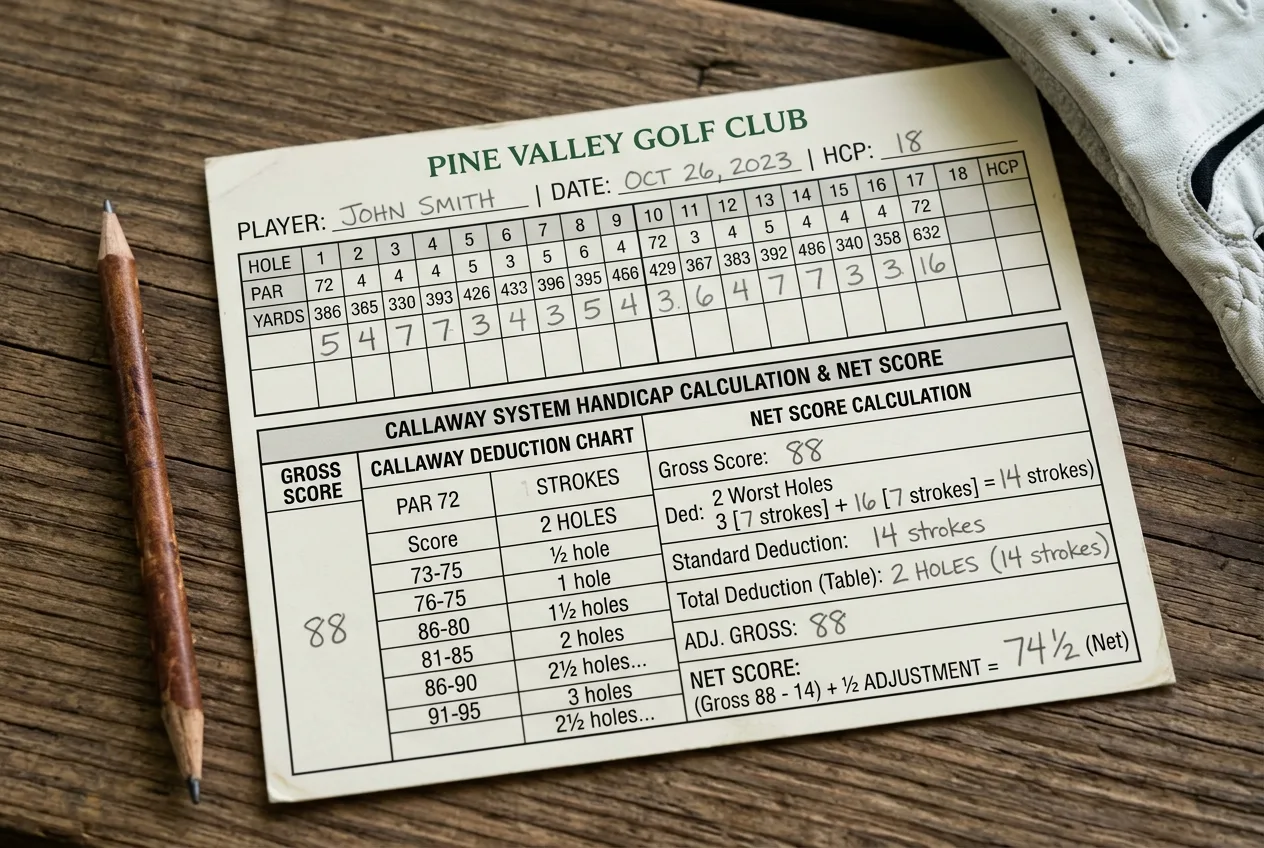
How the Callaway Scoring Mechanics Work
You start by recording your actual strokes for all 18 holes. This raw number is your Gross Score.
Unlike a standard scramble where teams share the best shot, you play your own ball entirely.
Once your round finishes, you consult a specific table. This table tells you how many strokes you can remove from your Gross Score.
After you subtract those strokes, you get your final Net Score. The player with the lowest Net Score wins the event.
The Callaway Deduction Chart Explained
The magic happens inside the official deduction chart. First, you calculate your Adjusted Gross Score (your total strokes with a maximum limit per hole).
You find that total number on the chart.
The chart then tells you exactly how many of your worst holes you can deduct. Sometimes the chart awards you half strokes.
If you receive a half stroke, you simply round up to the next whole number.
You then identify the highest scores on your scorecard. You subtract those specific scores from your total to find your final result.
Step-by-Step Example: Calculating Your Net Total
Let’s say you shoot an 85. However, one of those holes was a disaster where you scored a 9 on a par 4.
The system applies a Double Par maximum limit. You must reduce that 9 to an 8 before checking the chart.
Your new total becomes 84. You check the chart for 84. It allows you to deduct your two worst holes.
Your worst remaining holes are a 7 and a 6. You subtract 13 strokes from 84. Your net total is 71. You just shot under par!
3 Tips to Maximize Your Score in a Corporate Outing
Playing in a Corporate Golf Outing requires a smart strategy. You want to outsmart the system without breaking any rules.
- Play Safe on Par 5s: Avoid blowing up on long holes. A steady bogey is better than a risky triple bogey.
- Accept Bad Breaks: Do not panic after a terrible hole. The system will likely deduct it anyway.
- Know the Format: Always ask the organizer which of the corporate golf outing formats they are using before you tee off.
Callaway vs. Peoria System: Which is Fairer?
Organizers often debate between this system and the Peoria system for a weekend charity event.
Peoria selects six secret holes after the round to determine your handicap. It relies heavily on blind luck.
Callaway evaluates your entire round. It punishes consistent bad play but forgives isolated mistakes.
We believe Callaway offers a much fairer test of actual golfing ability. It removes the randomness that often frustrates players.
The 17th and 18th Hole Exception
Remember that hidden trap from the introduction? Here is the secret. You absolutely cannot deduct the 17th and 18th hole.
Even if you shoot a 10 on hole 18, you must keep that score.
The creators added this rule to prevent players from intentionally tanking the final holes to gain a bigger deduction.
You must stay focused and finish strong. A meltdown on the 18th green will ruin your final score.
Why Unhandicapped Players Love This System
This format brings genuine excitement back to casual golf. You get to enjoy a competitive atmosphere without needing an official handicap index.
It rewards steady play, forgives those inevitable blow-up holes, and keeps the math relatively simple.
Grab a cheat sheet, trust the process, and go claim your trophy at the next weekend tournament.
Frequently Asked Questions
What is the maximum score allowed on a hole in the Callaway system?
In the Callaway system, the maximum score allowed on any single hole is double par. This means if you are playing a par 4, the highest score you can record for deduction purposes is an 8. This rule prevents intentional blow-up holes.
How do you calculate half strokes in Callaway scoring?
Half strokes are calculated during the deduction phase. If your adjusted gross score dictates you receive a half stroke deduction based on the chart, you apply it to your worst holes and round up. For example, a 1.5 deduction becomes a 2-stroke deduction.
Can you deduct the 17th and 18th holes in Callaway scoring?
No, a fundamental rule of the Callaway scoring system is that the 17th and 18th holes cannot be deducted, regardless of how poorly you played them. This exception keeps the final holes competitive and prevents players from tanking their score intentionally.
Is the Callaway system good for a charity event?
Yes, the Callaway system is perfect for a charity event or corporate outing because it allows unhandicapped players to compete fairly. It assigns a one-day handicap based on their actual performance during the round, ensuring everyone has an equal chance to win.
What is the difference between Callaway and Peoria system?
Both are one-day handicap systems used for unhandicapped players. The Peoria system secretly selects six random holes to determine the handicap, relying heavily on luck. The Callaway system calculates deductions based on the player’s worst holes across the entire round, making it generally more accurate.
Get our latest guides, news, and insights highlighted in your Google Search & AI Overviews.