
✨ This article was AI edited. Editorial responsibility: GolfGearDirect.blog.
Instead, you want better feel, precise control of the ball’s flight and, above all, unwavering consistency that will give you confidence on every tee and fairway.
In short, you’re looking for something that will realistically help you get your total score below ninety, or even steadily approach the amazing mark of eighty shots per round.
But the vast majority of golfers who have a handicap between ten and twenty will sooner or later run into one huge problem. The golf equipment market is absolutely flooded with aggressive marketing slogans.
From the covers of magazines, manufacturers promise dozens of extra meters, absolutely incredible tolerance for the worst mistakes and magical space technology. Ordinary players are understandably extremely confused by this information overload.
They often ask themselves the same fundamental question. Should I choose a massive and forgiving “game improvement” model for my game? Or do I have a mature enough swing to safely transition to a sleeker, slimmer “players distance” iron?
Unfortunately, the result of this dilemma is often that the golfer makes the wrong choice. He buys a club that either doesn’t forgive him any mistakes at all, or, on the contrary, a club with which he can hit the ball very easily, but after impact he has no idea how far the ball will actually fly and where it will land.
Imagine that overwhelmingly frustrating feeling that you probably know all too well. You are standing in the middle of a perfect fairway, the weather is beautiful and you have an ideal one hundred and thirty five meters left to the center of the hole.
You can pick up your favorite seven iron with absolute certainty. You set up behind the ball, make a smooth swing and hit the ball with a perfectly clean center hit.
The ball flies beautifully straight, has a perfect trajectory, but to your utter dismay, it inexplicably flies fifteen meters over the green and disappears into the deep sand bank behind the hole.
Your brand new irons cost you two more unnecessary shots on the score in a single moment. Exactly this crisis scenario is unfortunately becoming more and more common with many modern irons.
This is due to the endless pursuit of the maximum achievable distance, which has completely destroyed the all-important predictability in a number of models.
But this year, the rules of the game are fundamentally changing in the golf industry. This year, top engineers from the world’s leading golf brands came across a revolutionary approach to the very design and construction of the hitting surface.
This seemingly minor design detail, which is unfortunately completely ignored by the vast majority of recreational golfers when purchasing, will ultimately determine whether or not you will be playing the best golf of your life on the course.
And exactly this secret ingredient for gaining perfect control over your wounds, we will reveal in detail in the very next paragraphs.
Table of Contents
- What are the best golf irons for mid handicap players?
- Players Distance vs. Game Improvement: Which Category Is For You?
- Key Technologies for 2026: AI and Precision Dispersion
- How to choose the right golf irons for mid handicap players: A step-by-step guide
- Why custom fitting (measurement) is absolutely essential
- Myths about mid-handicap irons
- Comparison of popular models: TaylorMade, Mizuno, Srixon and more
- Final summary: Where to go next?
- Frequently Asked Questions
What are the best golf irons for mid handicap players?
The broad mid-handicap category usually includes all players whose current HCP is in the fairly wide range of ten to twenty.
You really know how to play quality golf and can safely hit the ball regularly close to the center of the face.
You can easily play a solid par and occasionally score beautiful birdies.
Your enemy is nowkonzistence. One time you hit a beautiful shot, but the next you hit the clubhead or too close to the foot.
This is exactly why you are looking for golf irons for mid handicap players, the ideal golden mean.
The thin topline of the clubhead adds visual confidence, while the smaller offset makes it easier to match the club to the target.
At the same time, you need the stick to be able to reliably save even a badly hit shot at a critical moment.
Today, this category is dominated byplayers distanceirons.
These top-of-the-line clubs hide state-of-the-art technology, such as special tungsten weights for a low center of gravity.
This gets the ball high in the air even if your swing doesn’t have perfect momentum.
The key performance parameter is the so-calleddisperze ran(area dispersion in width and distance).
A quality premium iron will maintain a narrow and predictable dispersion.
If you hit the ball off-center, the club will maintain a steady carry distance and you will lose a maximum of three to five yards.
Players Distance vs. Game Improvement: Which Category Is For You?
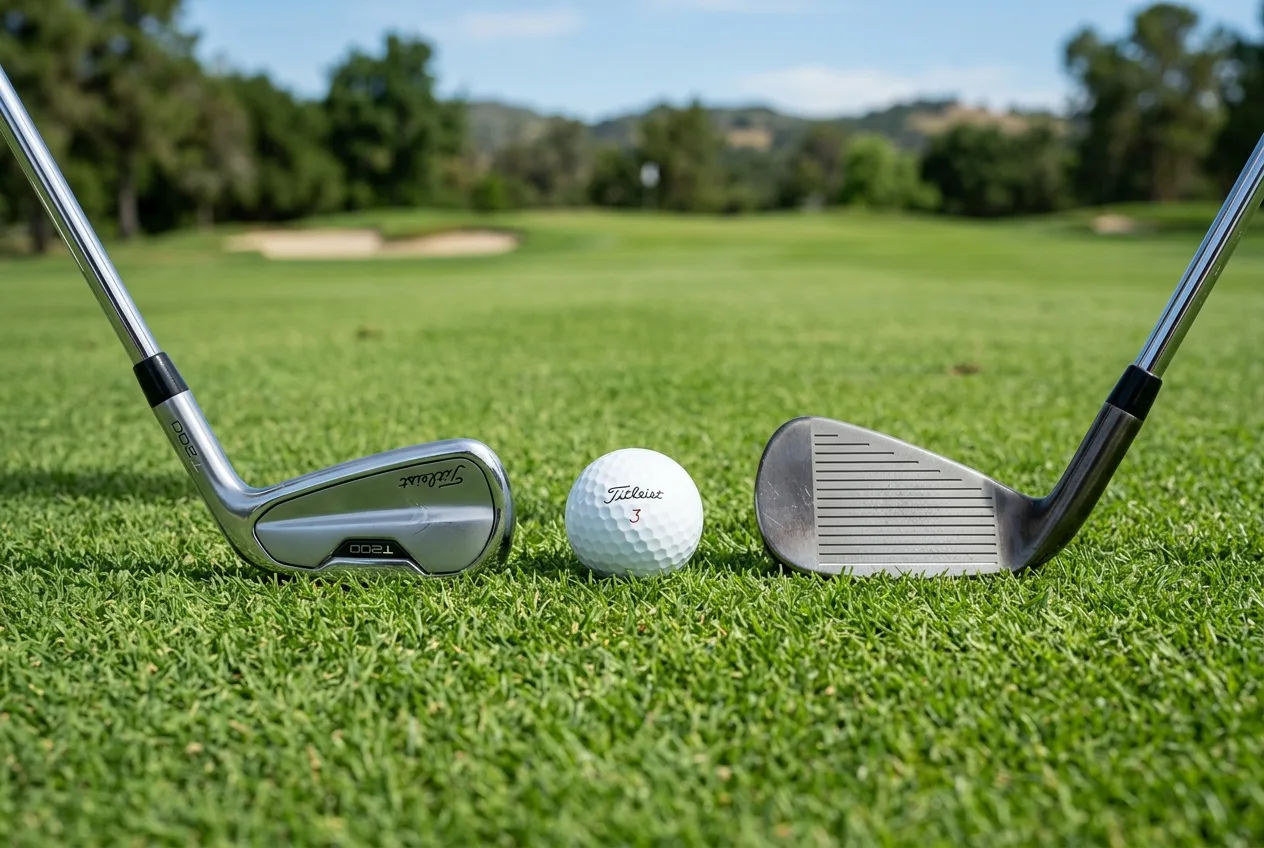
Game Improvement
They have a massivecavity backconstruction with heavy mass on the outer edges. These clubs will get the ball very high and far even on worse shots. They are extremely forgiving, but due to the heavy hitting surface, they give the player almost no feedback, which hinders the further improvement of intermediate golfers.
Players Distance
They use an advancedhollow bodyconstruction, where the cavity in the head is often filled with polymer foam that dampens vibrations. The extremely thin hitting surface flexes like a trampoline. They provide wider playing creativity, the ability to precisely shape shots and clear feedback after each stroke.
While older game improvement irons are built primarily for straight flight, hollow point irons offer the more advanced player much more game creativity.
Many players often rebuild their entire game set at once and carefully search for modern ones as wellgolf drivers, which perfectly complement their new, faster and more accurate swing.
Key Technologies for 2026: AI and Precision Dispersion
The biggest technological change is the revolutionary involvement of artificial intelligence in golf club design.
Traditional manufacturers no longer want to achieve just one absolute longest shot at the cost of inaccuracies.
The crazy pursuit of net distance in the irons is finally over.
Inconsistent shot lengths downright ruin the scores of the vast majority of recreational players.
Artificial intelligence can now analyze hundreds of millions of golf swings in real time.
They model all the places on the hitting surface where recreational players make mistakes most often.
Thanks to this, unique material thicknesses are created on the back side of the hitting surface.
Middlesweet spotcan be thicker to reduce the trampoline effect of perfect shots.
On the other hand, the edges near the heel and toe are milled to extreme thinness for maximum flexibility in the event of a mishit.
What does this mean in practice? Huge jump in parameterforgiveness. With the Callaway Apex Ai300 or Srixon ZXi4, the ball gets more spin after a miss and launches at a different angle, but ends up the same distance as a center hit.
In addition, innovative processes such as i-FORGED take the game feeling to the level of professional instruments, and artificial intelligence effectively removes the trade-offs between distance and accuracy.
How to choose the right golf irons for mid handicap players: A step-by-step guide
There is no way you should rush the selection of brand new clubs.
When choosing new golf irons for mid handicap players, focus on three key steps.
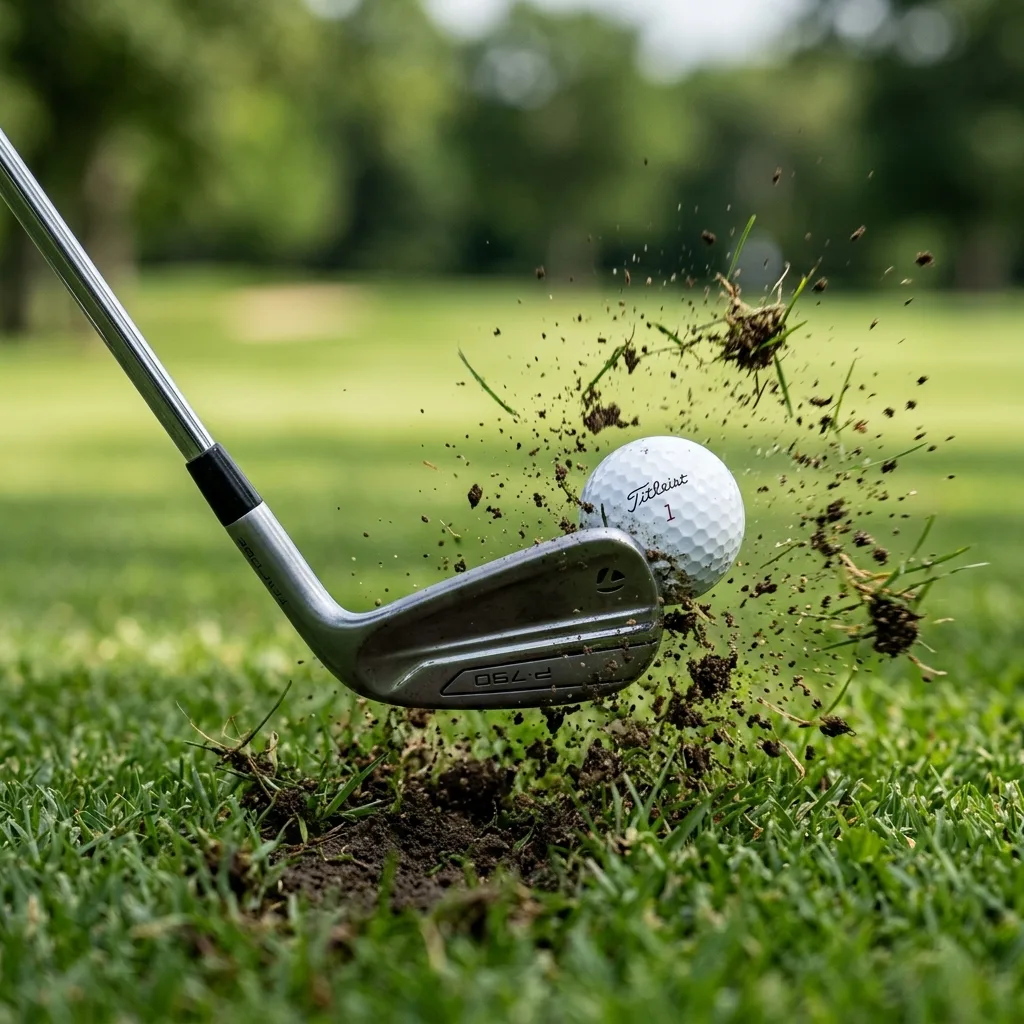
1. Turf interaction:The shape of the bottom edge determines how smoothly the club will pass through the grass after impact.
For a steeper swing, you need a wider edge to prevent the club from digging in.
If you tend to just ‘cut’ the grass, a narrower profile will suit you. Always test your clubs on real grass!
2. Skladba setu (combo sety):More and more players are switching to combo sets.
Long irons have larger heads from the game improvement category for tolerance of bad shots.
Short irons have more accurate heads for perfect control of passes towards the green.
3. Swing Error Analysis:Consider where on the court you most often hit the ball. For bottom edge hits, you need a deep center of gravity like the TaylorMade P790 offers.
Why custom fitting (measurement) is absolutely essential
Buying irons off the rack without measuring is like buying a suit without trying it on.
Professional custom fitting is easily available today and is an unquestionable necessity for medium handicaps.
An expert on the radar analyzes the swing speed and chooses the idealshaft.
For an athletic swing, a stiffer steel shaft is suitable.
For a slower swing, the graphite shaft will help generate more head speed.
The correct shaft is essential for irons, fairway woods and yourdriver for distance.
The second critical parameter islie angle(the geometric angle between the shaft and the bottom edge).
An upright lie causes the heel to touch the ground earlier, sending the ball to the left.
A lie angle that is too flat will send the ball sharply to the right.
Correct lie angle can miraculously improve the directional accuracy of shots even without changing swing technique.
Myths about mid-handicap irons
There are a number of dangerous technical myths circulating among golfers that force them to make bad decisions. Let’s clearly refute the most common ones.
Myth 1: Forged iron blades make me swing better.
This is dangerous nonsense. Long-term gaming with heavy equipment will ruin the game.
You will suffer from low flight, distance losses and unpleasant painful vibrations.
Better choose modern and forgiving advanced models from the proven players distance family.
Myth 2: I’m looking for a seven that flies over 160 meters.
Golf is not a competition for the longest tee. It’s not important what you hit the hole with, but reliability.
Modely jako Mizuno JPX 925 Hot Metaloffer great length, but above all, predictable control over final distance.
Myth 3: Graphite shafts are only for seniors and women.
This notion is outdated. The cutting edge technology of today’s graphite shafts has made a huge technological leap.
Many PGA Tour stars play with graphite shafts because they are great at dampening vibrations and helping to protect the joints.
Enable incredibly detailed micro-distribution of weight for optimal balance.
Comparison of popular models: TaylorMade, Mizuno, Srixon and more
Today’s market offers fantastic playing options. Here’s an expert review of the hottest premium models in the players distance category.
TaylorMade P790:These legendary irons defined the hollow body club category. They use smart tungsten weights designed by artificial intelligence. Thanks to the SpeedFoam Air foam, they provide a soft feel on impact and are the ideal choice for narrow dispersion and stable distance.
Mizuno JPX 925 Hot Metal:The Japanese brand embodies the perfect feel of the hitting surface. It uses chrome-molybdenum steel for an extremely thin but strong club front. It ensures a large sweet spot and perfectly handles even broken shots hit too low.
Srixon ZXi4:If you want the perfect interaction with the ground, Srixon’s patented V-Sole edge is second to none. It glides smoothly on the grass and prevents the tip from digging deep into the wet ground.
Titleist T250 a Ping G440:T250 forms the perfect connecting bridge between the classic razor profile and the forgiving shape. The Ping G440 targets players looking for absolute forgiveness, a larger profile and a steeper launch angle. Purist models such asMizuno Pro M-15or the JapaneseTakomo 301 CBfor sports precision complement them perfectly.
Final summary: Where to go next?
Club selection isn’t about finding a magic club that will hit every ball straight for you.
It’s about finding reliable gear that will limit the consequences of your errant shots.
Your bad shot should end up safely at the edge of the green, not lost deep in the woods.
Kategorie players distancewith hollow body construction offers powerful intelligent tools.
Combine the beautiful aesthetics of pro clubs with hidden support for the weekend player.
Limit your pursuit to the maximum reachable distance from a single magic hit.
Focus on swing reliability, tight dispersion and predictable distances on your shots.
Don’t forget to invest in professional custom fitting from an authorized specialist. It is the best financial move for your future golf growth.
Switching to new irons is a big step, but if you make the right choice, your handicap will plummet and your enjoyment of the game will skyrocket.
Frequently Asked Questions
What is the difference between beginner irons and intermediate handicap irons?
Irons for beginners (super game improvement) offer maximum forgiveness and a large head. Irons for medium handicap (often players distance) have a smaller profile, better feel when hitting, allow easier shaping of shots, but still maintain a reasonable level of forgiveness for inaccuracies.
Are forged irons suitable for a medium handicap?
Yes, modern forged irons from the ‘players distance’ category (e.g. Mizuno Pro M-15) are, thanks to innovative constructions such as the hollow body, sufficiently forgiving even for a medium handicap, while providing a top-notch feel when hitting.
Should I get steel or graphite iron shafts?
Shaft selection depends on your swing speed and physical condition. Steel shafts offer more control and accuracy for faster swings, while graphite shafts dampen vibration and help players with slower tempos gain speed. Custom fitting will determine the exact choice.
What is lie angle and why is it important in irons?
Lie angle is the angle between the lower edge of the club and the shaft. The correct lie angle ensures that the club head hits the ground flat at impact. A bad angle leads to loss of accuracy and dispersion. It is a key parameter when fitting.
Is it better to buy a whole set of the same irons or a combo set?
For many mid-handicap players, combo sets are an excellent choice. They offer more forgiving heads on the long irons (No. 4, 5) and more accurate, compact heads on the short irons for better pass control.
Get our latest guides, news, and insights highlighted in your Google Search & AI Overviews.