
Finding the right laser range finder for golf directly determines how confidently you attack the pin.
We tested over two dozen top-tier and budget models this year, analyzing them for exact yardage readouts, battery endurance, and ease of use in adverse weather.
Many golfers default to buying whatever Bushnell device they see on tour, assuming a higher price guarantees lower scores.
We found that simply isn’t true. Modern technology has leveled the playing field, bringing premium functionality to everyday players.
You want a device that locks onto the flag instantly, cuts through morning fog, and survives an unexpected downpour.
You also want to avoid paying a premium for features you will never use on the course.
We analyzed the market to separate the genuine game-changers from the overpriced gadgets.
But during our extensive field testing, we uncovered a hidden flaw in how most players use their optics—a mistake that completely ruins yardage accuracy when you need it most.
And the solution is hidden in the display settings you probably never touch.
Table of Contents
- What is the Best Laser Range Finder for Golf?
- Key Features: Slope Adjustment, Pin-Lock, and Optics
- AI & Ecosystem Connectivity: TrueSlope and Bluetooth Sync
- How to Choose the Right Laser Range Finder for Golf for Your Skill Level
- Tips for Maintaining Clarity and Battery Life on the Course
- Laser Rangefinder vs. GPS Watch: Which Should You Buy?
- Tournament Legal Devices: What You Need to Know
- Your Path to Better Yardage Accuracy
- Frequently Asked Questions
What is the Best Laser Range Finder for Golf?
The best device on the market blends speed, durability, and optical precision into a single package.
We put the top models from Garmin, Voice Caddie, and several emerging brands through rigorous field testing.
Our methodology involved measuring distances against physical markers in various weather conditions, from bright midday sun to heavy overcast skies.
We discovered that raw distance measurement is no longer the main differentiator.
Almost every modern laser reads distances correctly within a yard.
What separates an exceptional tool from an average one is how quickly and reliably it delivers that information to your eye.
We heavily weighted ergonomics and mounting solutions.
A strong magnetic cart mount secures the unit over harsh bumps on the cart path, keeping it instantly accessible before your shot.
We also tested every model’s waterproof rating by exposing them to simulated heavy rain.
Devices with an IPX7 rating survived total submersion, making them indispensable during unpredictable weather.
A reliable rangefinder stands alongside a quality glove and proper spikes as one of the most essential golf accessories you can own.
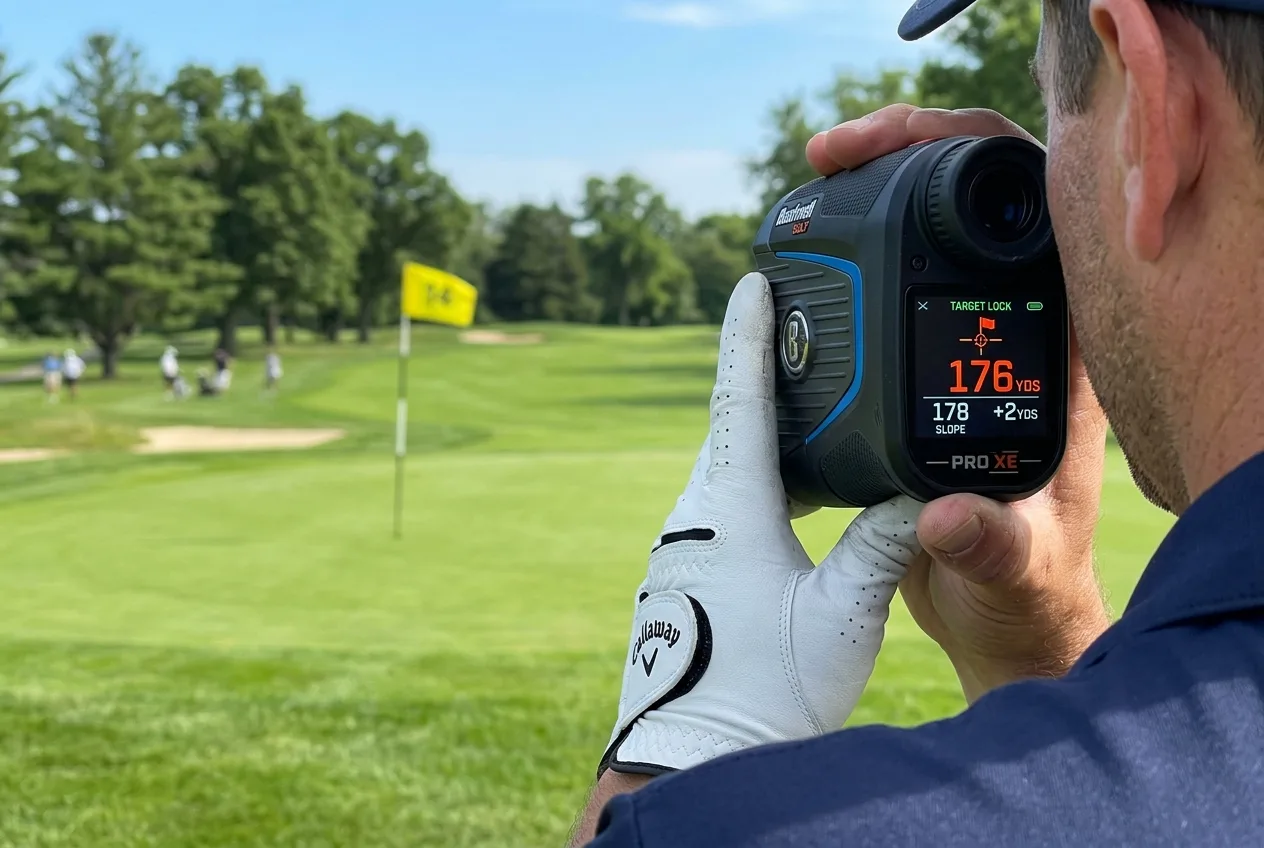
Key Features: Slope Adjustment, Pin-Lock, and Optics
Slope Adjustment: Understanding the technical specifications helps you make an informed purchase.
The most impactful feature for amateur golfers is slope adjustment.
This technology calculates the elevation change between you and the hole, delivering a highly accurate plays-like distance.
Slope compensation drastically improves club selection on hilly courses, preventing you from coming up short on an elevated green.
We consider this a mandatory feature for practice rounds.
Target Acquisition: Acquiring your target quickly prevents slow play.
Advanced pin-lock systems isolate the flagstick from background trees.
Once the laser secures the pin, the device delivers short vibration feedback.
This tactile confirmation, originally popularized as Jolt Technology, gives you immediate confidence in your yardage.
When paired with high-quality Pin-Seeker algorithms, you can lock onto the flag from over 300 yards away in under a second.
Visual performance relies entirely on the internal optics.
We strongly recommend choosing a device with a dual-color OLED display.
These screens allow you to toggle between red and black readouts depending on ambient lighting.
Red numbers dramatically enhance low-light visibility, ensuring you can easily read distances during early morning tee times or late afternoon twilight rounds.
A standard 6x magnification provides optimal clarity without amplifying the natural shake of your hands.
The combination of crisp magnification and a vibrant OLED display transforms how you view the golf course.
AI & Ecosystem Connectivity: TrueSlope and Bluetooth Sync
Golf technology in 2026 has moved beyond simple point-and-shoot mechanics.
The newest rangefinders leverage artificial intelligence to process environmental data in real-time.
TrueSlope technology represents a massive leap forward.
Instead of simply calculating elevation changes, TrueSlope algorithms analyze barometric pressure, temperature, and humidity to provide the exact playing distance.
Hitting a golf ball in the cold morning air requires more club than hitting the same shot in the afternoon heat.
These AI-driven devices do that complex math for you instantly.
Connectivity is the other major breakthrough.
Modern devices utilize seamless bluetooth sync to communicate directly with your smartphone app or smartwatch.
This creates a unified ecosystem for your golf data.
The new Range Relay feature allows players in the same foursome to share distance data effortlessly.
If you laser the pin from the fairway, your cart partner receives that exact yardage on their watch automatically.
This ecosystem sharing speeds up pace of play and provides a richer, data-driven experience on the course.
How to Choose the Right Laser Range Finder for Golf for Your Skill Level
Your handicap dictates which features provide the most value.
Beginners often struggle with hitting the ball consistently, so hyper-accurate environmental calculations might not translate to lower scores immediately.
If you shoot in the 90s or 100s, focus on speed and usability.
You want a device with fast target acquisition.
A model that quickly isolates the flag and delivers clear tactile feedback will give you the confidence to pick a club and swing without second-guessing your yardage.
Low handicappers require a different toolset.
If you consistently break 80, a discrepancy of three yards significantly impacts your proximity to the hole.
You need the precision of advanced environmental adjustments and ultra-clear optics.
We recommend investing in a premium unit with a heavy-duty metal housing and multi-coated lenses.
The slight increase in weight actually stabilizes the device in your hands, making it easier to hit a small target from 250 yards away.
Regardless of your skill level, prioritize ergonomics.
The unit must fit comfortably in your palm and feature intuitively placed buttons that you can operate with a single finger.
Tips for Maintaining Clarity and Battery Life on the Course
Even the most advanced laser requires proper maintenance to function at peak performance.
Dirt, sunscreen, and fingerprint smudges on the lenses severely degrade optical clarity and slow down the laser’s measuring speed.
Keep a microfiber cloth in your bag and wipe the lenses clean before every round.
Never use your shirt or a rough towel, as these materials create micro-scratches on the lens coatings over time.
Battery management separates prepared golfers from frustrated ones.
Most devices use CR2 lithium batteries, which typically last for 40 to 50 rounds.
However, leaving your rangefinder in the trunk of your car during extreme heat or freezing cold will rapidly deplete the battery life.
Store the device indoors at room temperature between rounds.
We also recommend carrying a spare battery in your golf bag at all times.
A dead laser on the first tee forces you to rely entirely on course markers, which ruins your system for accurately determining yardages.
Laser Rangefinder vs. GPS Watch: Which Should You Buy?
- Exact distance to specific targets
- Pinpoint accuracy on approach shots
- You control exactly what is measured
- Useless on blind shots
- Requires steady hands to operate
- Takes longer than glancing at a watch
Many golfers debate whether a laser or a wearable GPS device provides a better return on investment.
A laser gives you the exact distance to the flagstick, the lip of a bunker, or a specific tree on the dogleg.
You control exactly what you measure.
This pinpoint accuracy is unmatched, especially on approach shots where knowing the exact distance to the pin dictates your club selection.
A GPS watch, conversely, provides front, middle, and back green yardages at a glance without requiring you to aim a device.
Watches excel on blind shots where you cannot physically see the flag.
They also track your score and map your shots effortlessly.
For a deep dive into the differences, check out our comprehensive breakdown of a rangefinder compared to a GPS watch.
Ultimately, competitive players often carry both: they use the GPS for quick baseline yardages and the laser to lock onto the precise pin location.
Tournament Legal Devices: What You Need to Know
If you plan to play in official club championships or sanctioned events, you must understand the rules regarding distance-measuring devices.
The USGA and R&A allow the use of lasers to measure distance.
However, using slope functionality or environmental calculations during a competitive round violates the rules and results in immediate disqualification.
To ensure your device is Tournament Legal, it must feature a physical switch or visible indicator that disables the slope feature.
Modern devices utilize bright LED rings or colored faceplates that clearly signal to your playing partners that the device is operating in tournament mode.
Always verify the local rules before teeing off, and explicitly announce to your group that your slope function is turned off.
Your Path to Better Yardage Accuracy
Equipping yourself with the right optical tool fundamentally changes your approach to the game.
You eliminate the guesswork from your club selection and step into every shot with absolute conviction.
Prioritize a device that offers rapid target lock, a bright display, and a comfortable ergonomic grip.
The investment pays immediate dividends in the form of tighter approach shots, shorter putts, and consistently lower scores.
Grab your laser, trust your yardage, and start attacking the pin.
Frequently Asked Questions
Do I really need slope adjustment on my golf rangefinder?
Slope adjustment calculates the elevation change between you and the hole, providing a highly accurate plays like distance. While crucial for practice and casual rounds to improve club selection, remember that slope functionality must be turned off during official tournaments. Read more about accurately determining yardages.
What is the benefit of a dual-color OLED display?
A dual-color OLED display features crisp red and green optics that automatically adjust to ambient lighting. This dramatically enhances clarity and low-light visibility, ensuring you can easily read yardage accuracy even on overcast days or during early morning tee times.
How does pin-lock or Jolt technology work?
Pin-lock technology isolates the flagstick from background objects. Once the laser range finder for golf acquires the target, it delivers a short vibration feedback called Jolt. This gives the golfer instant confidence that they have locked onto the correct distance.
Are budget golf rangefinders just as good as premium brands?
Many budget golf rangefinders offer excellent yardage accuracy and basic slope features. However, premium brands often provide superior build quality, advanced AI-driven environmental adjustments, better waterproof ratings, and significantly faster target acquisition speeds for more reliable on-course performance.
How do I keep my laser range finder steady if I have shaky hands?
If you have shaky hands, look for a laser range finder for golf with built-in image stabilization and strong magnetic cart mounts. Additionally, using both hands and bracing your elbows against your chest can significantly improve stability and target acquisition speed on the course. Learn about essential golf accessories.
Get our latest guides, news, and insights highlighted in your Google Search & AI Overviews.