
✨ This article was AI edited. Editorial responsibility: GolfGearDirect.blog.

The best wedge for mid handicapper golfers is a cavity-back design that offers maximum forgiveness rather than a traditional blade meant for tour professionals.
The best wedge for mid handicapper golfers is a cavity-back design that offers maximum forgiveness. Unlike standard blades, cavity-back wedges redistribute weight to the perimeter, stabilizing the clubhead on off-center strikes and dramatically improving consistency.
We see it every weekend on the course: a 15-handicap golfer struggling to get out of a bunker or chunking a simple chip because they bought the same wedges their favorite pro plays on TV.
You might think those sleek tour blades will magically improve your short game, giving you the ability to nip the ball cleanly off tight lies. However, the reality is that without the consistent strike of a professional, those clubs are costing you precious strokes every single round.
For mid-handicappers shooting in the 80s or low 90s, the short game is exactly where the most significant scoring improvements happen. Yet, many players actively handicap themselves by choosing equipment that demands absolute perfection on every swing.
There is a specific design feature that can instantly solve those fat chips and rescue your scorecard, but most amateur golfers completely ignore it when shopping. Do you know what to look for?
Table of Contents
- What is the best wedge for mid handicapper?
- Cavity-Back vs. Blade Wedges for Mid Handicaps
- Understanding Bounce Angle and Sole Grind
- Top 7 Wedges for Mid Handicappers in 2026
- How to Build the Perfect Wedge Setup
- Do Mid Handicappers Really Need Tour Wedges like Vokey?
- Transitioning from Game-Improvement Irons
- Final Verdict: Choosing Your Ideal Wedge
- FAQ: Frequently Asked Questions
What is the best wedge for mid handicapper?
If you are looking for the absolute best wedge for mid handicapper, your primary focus must be on a cavity-back profile.
Unlike standard wedges that concentrate mass directly behind the center of the clubface, a cavity-back wedge redistributes the weight out to the perimeter of the clubhead.
This perimeter-weighting design directly mirrors the technology found in your standard irons, right down to your Pitching Wedge.
When you miss the center of the face—which happens frequently for amateur players—the perimeter weighting actively stabilizes the clubhead through impact.
A prime example of this category is the Cleveland CBZ, which brings game-improving technology straight into your scoring clubs, ensuring your mishits still end up near the pin.
By utilizing a cavity-back, the club resists twisting when the ball is struck toward the toe or heel. This increased stability translates to significantly better distance control, ensuring your approach shots fly the intended yardage rather than falling woefully short into a greenside bunker.
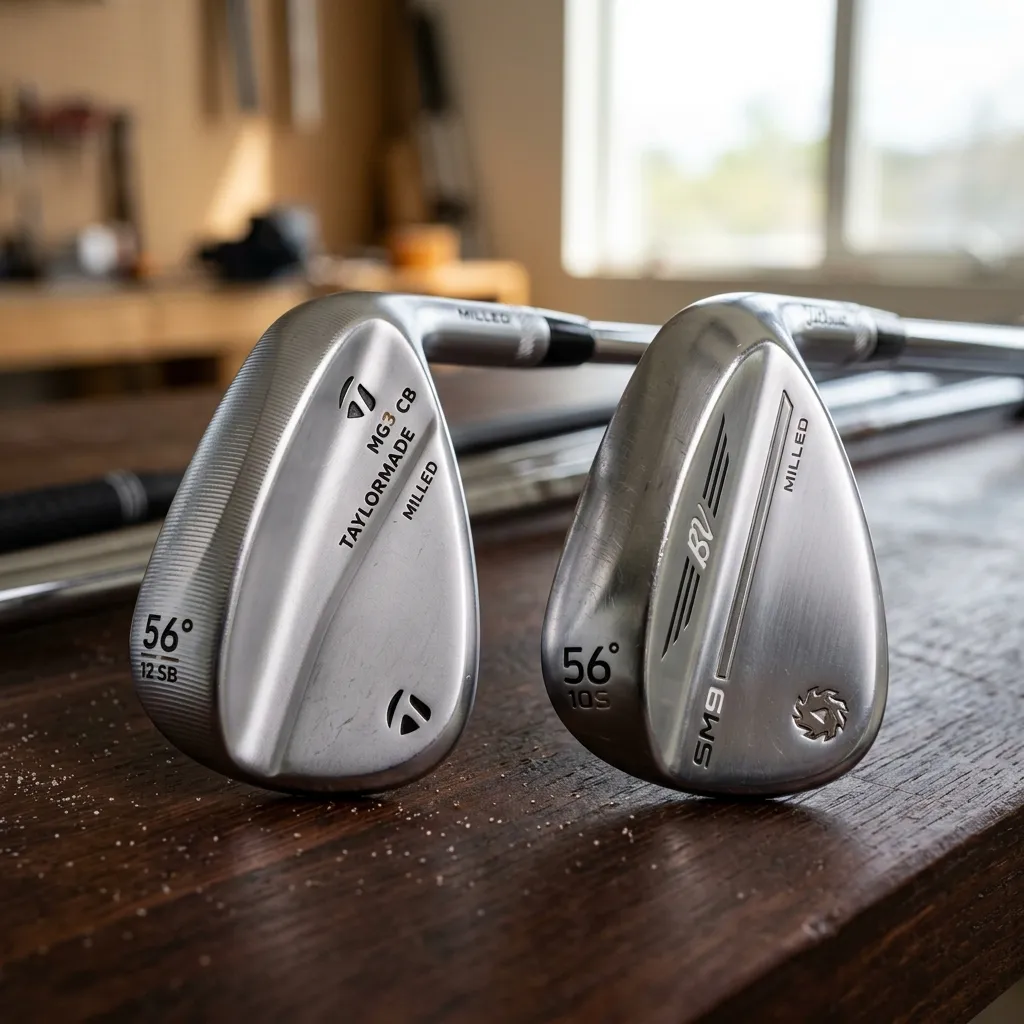
Cavity-Back vs. Blade Wedges for Mid Handicaps
The persistent debate between cavity-back and blade wedges ultimately comes down to a battle of consistency versus workability.
Blade wedges feature a significantly smaller sweet spot, rewarding players who possess the skill to strike the ball perfectly every single time.
If you miss that tiny optimal zone on a blade, the club twists aggressively in your hands, resulting in lost distance, poor accuracy, and a harsh feel vibrating up the shaft.
Conversely, when transitioning from game-improvement irons, stepping into a forgiving cavity-back wedge makes the most logical sense for your game.
You are already accustomed to looking down at a slightly thicker topline and a wider sole, so a cavity wedge inspires immediate confidence at address.
Brands are innovating rapidly in this space; for instance, modern clubs now incorporate advanced materials like Urethane microspheres—a vibration-dampening technology prominently seen in the Callaway Opus SP—to improve feel while retaining immense stability on off-center hits.
This means you no longer have to sacrifice that buttery-soft feel around the greens just to get the forgiveness your swing fundamentally requires.
Understanding Bounce Angle and Sole Grind
Navigating modern wedge specifications can feel like learning an entirely new language, but getting it right is absolutely crucial for a mid handicapper.
The two most critical terms you must understand are bounce angle and sole grind. Bounce is simply the angle created between the leading edge of the club and the lowest point of the sole. It dictates exactly how the club travels through the ground upon impact.
A higher bounce (typically 10 to 14 degrees) prevents the club from digging deeply into soft ground, lush grass, or fluffy sand. It acts remarkably like the hull of a boat, skipping through the turf rather than plunging into it.
Grind refers to the specific material removed from the sole, heel, and toe of the clubhead, allowing you to manipulate the clubface for different types of shots without the leading edge lifting too high off the ground.
Optimizing both of these elements directly improves your overall turf interaction. Mid handicappers generally benefit the most from a mid-to-high bounce, as it provides a much wider margin for error on slightly fat shots.
If you want a deeper dive on getting these specifications dialed in perfectly for your specific swing, read our comprehensive guide on choosing the correct bounce to match your local course conditions.
Top 7 Wedges for Mid Handicappers in 2026
The wedge market in 2026 offers incredible options specifically tailored for mid-level players seeking enhanced consistency. Here are the top contenders that deserve a permanent spot in your golf bag:
- Cleveland CBZ: The undisputed king of forgiveness. Cleveland has mastered the cavity-back wedge category, and the CBZ features a massive hollow chamber that pushes weight to the extremes. It is incredibly easy to hit full shots with, while still providing ample spin around the greens.
- Callaway CB 12: Designed to take the guesswork out of the short game entirely. It delivers exceptional feel with specialized urethane inserts and utilizes aggressive micro-milling across the face for maximum friction and spin on partial shots.
- Cobra KING: Features a highly versatile notch design on the sole that helps the club glide smoothly through the turf. The wider sole combined with progressive groove technology makes it highly predictable from virtually any lie.
- TaylorMade Hi-Toe 4: Features a distinctive high toe profile that physically expands the hitting area. This larger face is perfect for opening the clubface in deep rough or green-side bunkers, giving mid handicappers extra confidence.
- Takomo Skyforger 002: A fantastic direct-to-consumer option offering a premium forged feel without the hefty premium price tag. It features a slightly thicker profile that blends beautifully with cavity-back irons.
- Titleist Vokey SM11: While technically a blade profile, specific sole options in the SM11 lineup—like the F or K grind—provide enough sole width and bounce to offer genuine help for the better mid-handicapper seeking tour-level spin.
- Mizuno S24: Combines a classic, aesthetically pleasing teardrop shape with a subtle tri-sole design. This unique sole geometry assists with versatility around the greens, allowing you to hit square-faced chips and open-faced lobs with equal ease.
How to Build the Perfect Wedge Setup
Buying a single club is rarely enough to solve your short-game woes; you need to build a cohesive scoring system. Proper loft gapping ensures you do not face awkward distance gaps when approaching the green from 100 yards and in.
Most modern pitching wedges have incredibly strong lofts, often sitting around 43 or 44 degrees.
To bridge the substantial yardage gap between that strong pitching wedge and a standard sand wedge, you absolutely need a Gap Wedge (typically around 48-50 degrees).
This club becomes your dependable workhorse for full swings from 90 to 110 yards.
Following that, a reliable Sand Wedge (54-56 degrees) with ample bounce is mandatory for bunker play and thick rough.
Finally, adding a Lob Wedge (58-60 degrees) is fantastic for hitting creative shots around the green when you need to get the ball up quickly and stop it fast.
Maintaining a consistent 4-to-5 degree gap between each of these clubs will drastically improve your distance control and eliminate the need for tricky half-swing calculations.
Do Mid Handicappers Really Need Tour Wedges like Vokey?
It is incredibly easy to get caught up in the marketing hype and buy exactly what the professionals are playing on television.
However, tour wedges demand a level of precision, swing speed, and strike consistency that most amateur players simply do not possess.
When you use an unforgiving blade wedge, those inevitable off-center strikes lead to short, frustrating shots that leave you scrambling to save bogey.
The sharp leading edges and narrow soles designed for elite ball strikers will mercilessly punish a slightly fat chip.
You do not need to play a tour wedge to shoot consistently lower scores. In fact, matching your wedges to the forgiveness level of your game-improvement irons will yield far better and more consistent results on the scorecard.
A cavity-back wedge will cover up your minor swing flaws, whereas a blade will only highlight them.
Transitioning from Game-Improvement Irons
Many golfers rely entirely on the matching wedges that came included with their iron sets. While a set-matching wedge offers great visual continuity from your game-improvement irons, it often lacks the specialized sole designs and aggressive groove patterns needed for tricky lies and bunker escapes.
Set wedges are generally designed for full swings from the fairway. Upgrading to a standalone, forgiving wedge gives you the absolute best of both worlds.
You retain the familiar, confidence-inspiring profile at address, but you gain the specialized grooves and sole grinds necessary for superior spin and versatility near the putting surface.
This transition is a critical step in lowering your handicap, as it provides you with the specific tools needed to execute high-spin chips, bunker blasts, and delicate pitches that a standard set wedge simply cannot handle effectively.
Final Verdict: Choosing Your Ideal Wedge
Your short game is the fastest path to lowering your overall handicap, and playing the right equipment is more than half the battle.
Ditch the ego, put away the tour blades, and fully embrace the consistency of modern, forgiving cavity-back designs.
By matching your swing with the correct bounce, grind, and head profile, you will instantly eliminate those chunked chips and dramatically improve your scrambling percentage.
A wedge that offers robust forgiveness on slight mishits will keep your ball in play and give you far more looks at par.
Take a hard look at the lofts on your current irons, establish proper gapping, and invest in wedges that actually help your game rather than making it harder.
FAQ: Frequently Asked Questions
Should a mid handicapper use a blade or cavity back wedge?
Most mid handicappers should opt for cavity-back wedges because they provide significantly more forgiveness on off-center strikes, whereas blade wedges require highly precise ball-striking to perform correctly.
What is the most forgiving wedge for an average golfer?
The Cleveland CBZ and Callaway CB 12 are widely considered among the most forgiving wedges available. Their cavity-back designs help stabilize the clubhead on mishits, promoting consistent distance and better accuracy.
How much bounce should a mid handicapper use?
A mid handicapper should generally start with 10 to 12 degrees of bounce. This mid-to-high bounce configuration offers maximum versatility across various turf and sand conditions without digging harshly into the ground.
Do I need a gap wedge as a mid handicapper?
Yes, a gap wedge is highly recommended to fill the substantial loft gap between your pitching wedge and sand wedge, ensuring you maintain consistent yardage gaps on all of your approach shots.
Are Vokey wedges good for a mid handicapper?
While Vokey wedges are undeniably excellent clubs, their blade-style design is tailored primarily for advanced players. Mid handicappers might find them intimidating and notably less forgiving than modern cavity-back alternatives.
Get our latest guides, news, and insights highlighted in your Google Search & AI Overviews.