
Finding the best golf grip for driver can instantly solve your slice and distance issues, yet countless golfers constantly tweak their swing while ignoring the one thing connecting them to the club.
The connection point dictates everything from face angle to swing speed. Even pros like Bryson DeChambeau have radically changed their game by switching to JumboMax grips to maximize control and dominate the US Open.
But there is a shocking truth about standard grips that might be quietly ruining your drives right now. What is it, and how can a simple $10 fix add 20 yards to your tee shots?
Table of Contents
- Corded vs Rubber Grips: Which Gives You Better Clubface Control?
- How Grip Sizing (Standard vs Midsize vs Jumbo) Affects Your Swing
- How to Find the Right Size and Install Your Driver Grip
- The Strong Grip Strategy for Slice Correction
- Top Grip Models for Big Hitters and Slice Fixes
- Common Driver Grip Mistakes You Must Avoid
- Final Verdict: Upgrading Your Driver Grip
- Frequently Asked Questions
Corded vs Rubber Grips: Which Gives You Better Clubface Control?
When choosing a new grip, the material is your first major decision. Rubber grips offer a softer feel and are excellent if you prefer a smooth, comfortable hold without abrasive feedback.
They are the standard for most casual players looking for a relaxed feel, absorbing vibration well on off-center hits. If you struggle with joint pain, pure rubber is often the safest bet to reduce shock traveling up the shaft.
For an even softer, more cushioned feel, wrap grips simulate the traditional feel of leather and are incredibly comfortable for players without gloves. These grips feature a continuous spiral wrap design that provides a tacky surface, encouraging a lighter hold. They are ideal for dry conditions but can become slippery in the rain.
However, if you play in wet conditions or have sweaty hands, corded grips provide maximum traction. They embed cotton fibers into the rubber, ensuring the club never slips, even in a downpour. This extreme traction means you don’t have to squeeze the club tightly to maintain control.
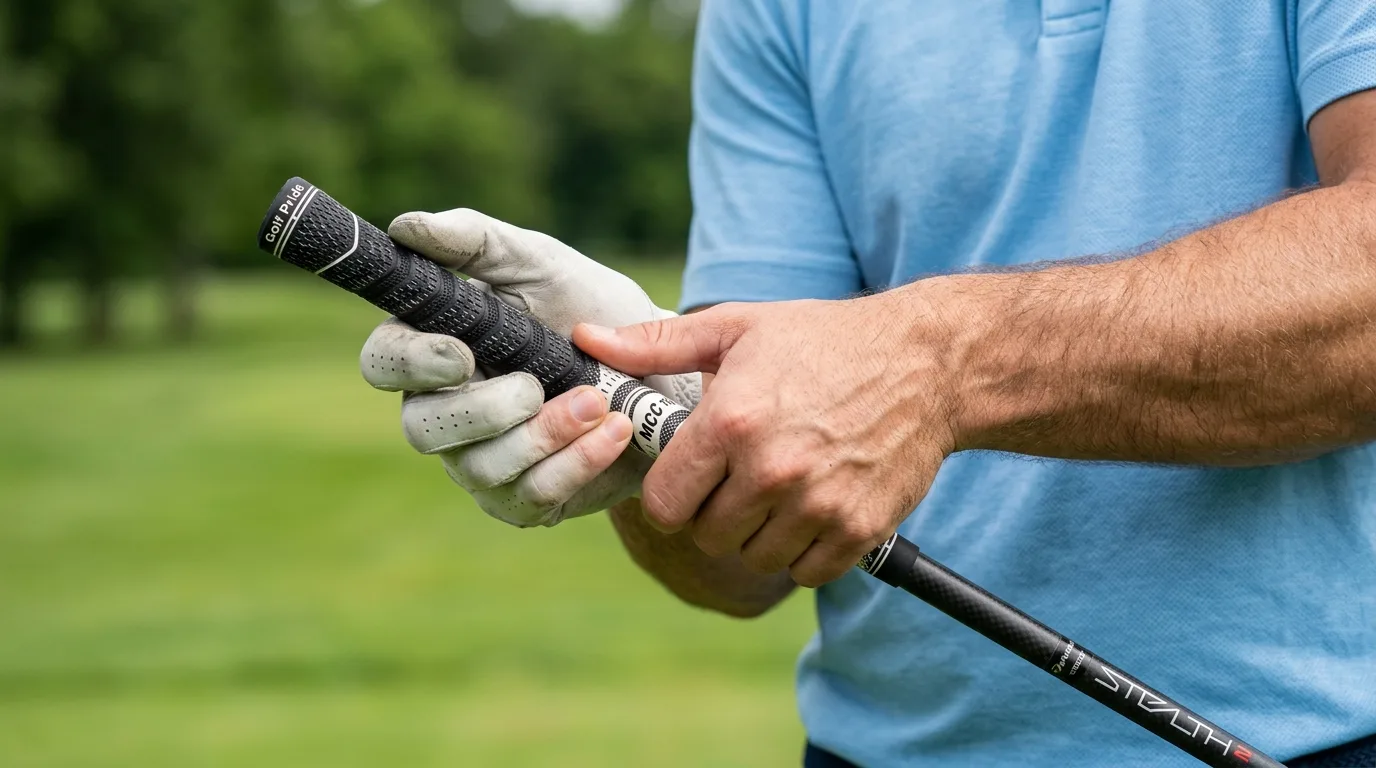
For the best of both worlds, multi-compound models blend a corded upper half for the dominant hand with a softer rubber lower half. This combination delivers exceptional clubface control, ensuring a more consistent release (the point where the clubhead squares up at impact) through the hitting zone. The firm upper hand provides stability, while the soft lower hand promotes a fluid release of the clubhead.
How Grip Sizing (Standard vs Midsize vs Jumbo) Affects Your Swing
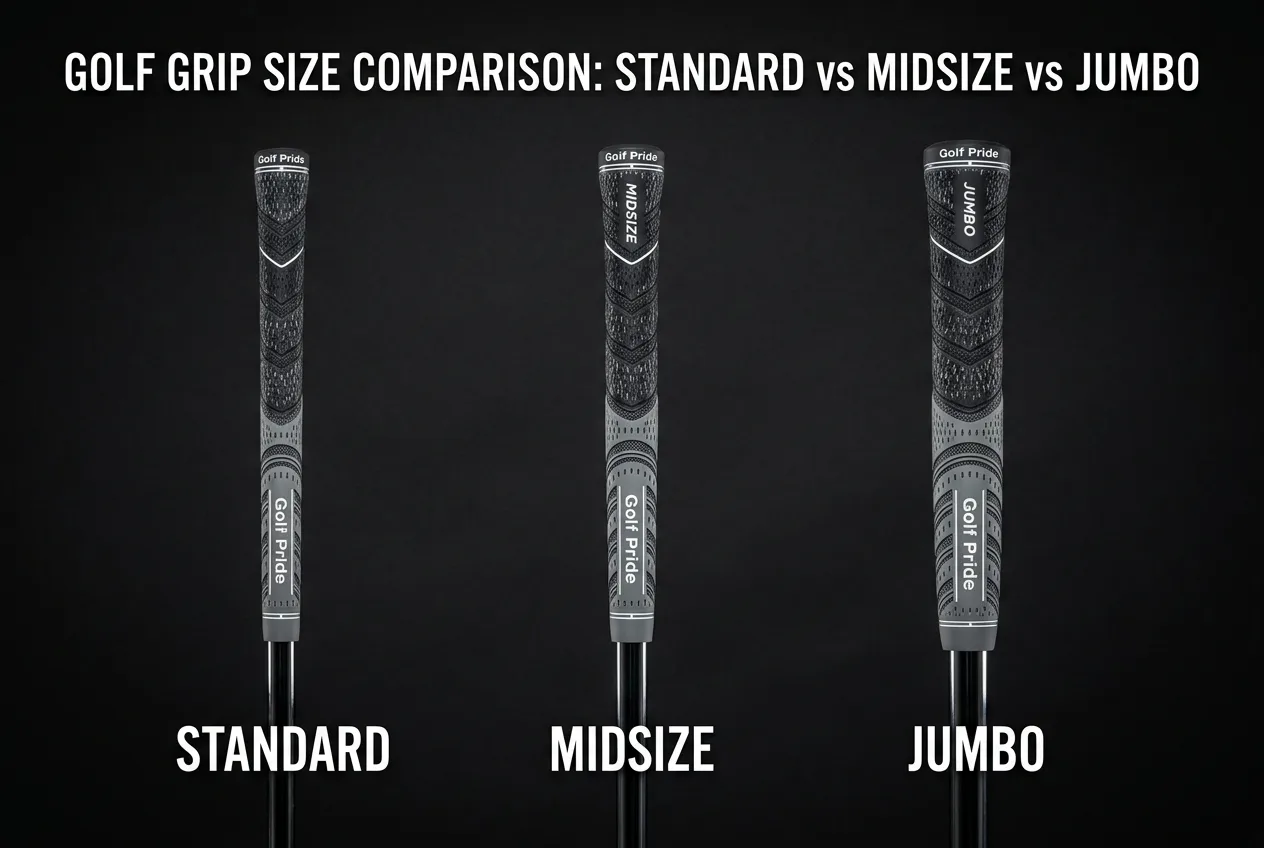
Grip size is arguably more critical than the material you choose. Most drivers come stock with standard grips, but playing the wrong size severely impacts your mechanics. A grip that doesn’t fit your hand size forces your body to compensate in ways that destroy accuracy.
If your grip is undersize (too small), your hands become overly active during the downswing. This excessive wrist action leads to a premature release and often results in a vicious hook. Your hands simply rotate too fast, closing the face before impact.
Conversely, stepping up to midsize grips or even jumbo grips can be a game-changer for slice correction. Larger grips force you to hold the club lighter, naturally reducing grip pressure. This is exactly why Bryson DeChambeau uses oversized JumboMax grips.
Less tension in your hands prevents you from manipulating the clubface too much. The larger circumference slows down the rotation of your hands, preventing the face from shutting too quickly, resulting in straighter, more powerful drives. For players with arthritis, the larger size also dramatically reduces hand fatigue.
How to Find the Right Size and Install Your Driver Grip
Determining your ideal size is straightforward and doesn’t require a professional fitting. When you hold the club, look at the tips of your middle and ring fingers on your top hand. They should just barely touch the pad of your thumb.
If they dig aggressively into your palm, the grip is too small. If there is a massive gap between your fingers and your thumb pad, the grip is too big.
Installing a new grip at home is a simple process that takes less than ten minutes per club. You just need a hook blade to safely remove the old rubber, double-sided grip tape, and plenty of grip solvent.
Upgrading the grip on your golf drivers is the most cost-effective performance enhancement you can make, far cheaper than buying a brand new club. Simply slide the new grip on, align it squarely, and let it dry for a few hours before hitting the course.
The Strong Grip Strategy for Slice Correction
Even with the perfect size and material, your hand placement dictates where the ball ultimately goes. Many slicers unknowingly use a weak grip, where the hands are turned too far to the left (for a right-handed golfer).
This weak position restricts your ability to rotate the club through impact, promoting a chronically open face. A neutral grip is standard, showing exactly two knuckles on the top hand when looking down.
To execute a powerful slice correction, try adopting a strong grip. Rotate both hands slightly to the right until you see three clearly visible knuckles on your top hand. This adjustment promotes an earlier, more natural wrist hinge on the backswing.
More importantly, it naturally encourages a closed face at impact without requiring conscious manipulation. It is a rapid fix that helps square the driver up, instantly straightening out that weak fade and turning it into a penetrating draw.
Top Grip Models for Big Hitters and Slice Fixes
If you are ready to make a change, a few standout models dominate the market and consistently perform well in our testing. The Golf Pride MCC is the absolute gold standard for multi-compound design.
It offers incredible all-weather performance, combining a corded upper for firm control with a responsive rubber lower half. It is the most popular choice on professional tours.
For those seeking ultimate comfort and vibration dampening, the Winn Dri-Tac provides a tacky, extremely soft feel. This polymer grip is perfect for players with joint pain or those who prefer a completely tension-free hold.
Finally, the Lamkin Crossline is a legendary, highly durable option that provides a consistent, firm feel for aggressive swingers. The dense rubber pattern offers incredible feedback and lasts significantly longer than softer alternatives. Testing these against your current setup can reveal exactly what you have been missing.
Common Driver Grip Mistakes You Must Avoid
The most destructive mistake amateur golfers make is gripping the club like a baseball bat with maximum force. High grip pressure travels straight up your arms, locking your shoulders and completely killing your swing speed.
Tension is the enemy of a fluid golf swing. You should hold the driver with a pressure of about 4 out of 10—firm enough that it won’t fly out of your hands, but soft enough to feel the weight of the clubhead.
Another common error is failing to replace worn, shiny grips. A slick grip forces you to squeeze tighter just to hold on, instantly ruining your mechanics and reintroducing tension.
Fresh rubber ensures you can maintain a relaxed hold while still maximizing power. If you are specifically looking to build a driver for distance, a fresh, correctly sized grip is a mandatory starting point. Without it, you are leaving yards on the table.
Final Verdict: Upgrading Your Driver Grip
Your driver grip is the steering wheel of your golf swing. Upgrading from a worn-out standard size to a fresh midsize or multi-compound option can instantly lower your scores and boost your confidence.
By reducing tension, promoting a better release, and providing superior traction, the right grip turns a frustrating slice into a powerful, controlled drive. Don’t let a cheap piece of rubber hold back your potential on the tee box. Invest in your connection to the club, and watch your driving statistics transform.
Frequently Asked Questions
What is the best golf grip for a driver?
The best golf grip for a driver depends on your hand size and swing type. Multi-compound grips provide all-weather traction, while oversized grips help reduce grip pressure and minimize a slice for better clubface control. Learn more.
Does driver grip size affect distance?
Yes, driver grip size affects distance and release. Midsize or jumbo grips can reduce tension in your hands, allowing for a smoother release and potentially more distance, whereas undersize grips might cause too much wrist hinge.
Should I use a corded or rubber grip for my driver?
Corded grips are ideal if you play in wet conditions or have sweaty hands, as they provide maximum traction. Rubber grips offer a softer feel and are better if you prefer less abrasive feedback on your hands.
How does a strong grip help with a slice?
A strong grip rotates your hands further to the right on the club. This promotes a closed clubface at impact, making it much easier to square the face and eliminate a slice off the tee.
How often should I change my driver grip?
You should change your driver grip at least once a year, or every 40 rounds. A worn grip causes you to hold the club tighter, which increases grip pressure, restricts your wrist hinge, and costs you valuable distance.
Get our latest guides, news, and insights highlighted in your Google Search & AI Overviews.