
✨ This article was AI edited. Editorial responsibility: GolfGearDirect.blog.
Finding the best golf driver shaft for me starts with matching your unique swing speed to the correct flex and weight.
If your drives are inconsistent, leaking right, or spinning out of control, the shaft is almost always the culprit rather than the driver head itself. A properly fitted driver shaft acts as the essential engine of your golf club, delivering the clubhead squarely to the golf ball at the exact moment of impact.
We tested hundreds of setups specifically for amateur golfers and high-mid handicappers who struggle with overall distance and accuracy. The most common mistake we witness on the driving range is players blindly guessing their equipment specifications instead of accurately analyzing their unique swing mechanics.
Upgrading to the right carbon fiber profile instantly tightens your shot dispersion and maximizes energy transfer. However, one specific 2026 technological advancement in heavy counterbalancing is changing everything about how we fit golfers.
If you are still playing a standard stock shaft from three years ago, you are likely losing up to 20 yards off the tee—and you will soon see exactly why.
Table of Contents
- How to Find the Best Golf Driver Shaft For Me
- Understanding Shaft Mechanics: Flex, Torque, and Kick Point
- How Your Tempo and Transition Affect Shaft Choice
- What is the best golf driver shaft for me? 5-Step Checklist
- Top 2026 Driver Shafts to Test (Fujikura, Mitsubishi, True Temper)
- The Driver Shaft Flex Myth: What Actually Matters
- Should You Get a Professional Fitting or DIY?
- Conclusion: Upgrading Your Shaft vs. Buying a New Driver
- Frequently Asked Questions
How to Find the Best Golf Driver Shaft For Me
To accurately determine the correct specifications, you first need to establish your baseline performance data. The most critical metric to capture is your absolute maximum and average clubhead speed.
This specific number dictates the overall stiffness and weight category you should be looking at during the initial fitting phase. If you swing a golf club at 90 mph, playing an extra-stiff profile will dramatically reduce your ball speed and cause low, weak slices that struggle to stay in the fairway.
Conversely, a player with a 105 mph clubhead speed using a senior flex shaft will constantly struggle to control the face at impact. The shaft will lag too far behind their hands, leading to massive two-way misses.
The primary goal is to find a structural profile that naturally optimizes your launch angle without forcing you to change your ingrained swing mechanics.
To get started on this optimization process, you must measure your driver swing speed accurately using a high-quality commercial launch monitor. Once you have that precise number, you can instantly eliminate 80% of the wrong equipment options on the market.
From there, you can narrow down the remaining choices by testing specific models within your targeted swing speed bracket.
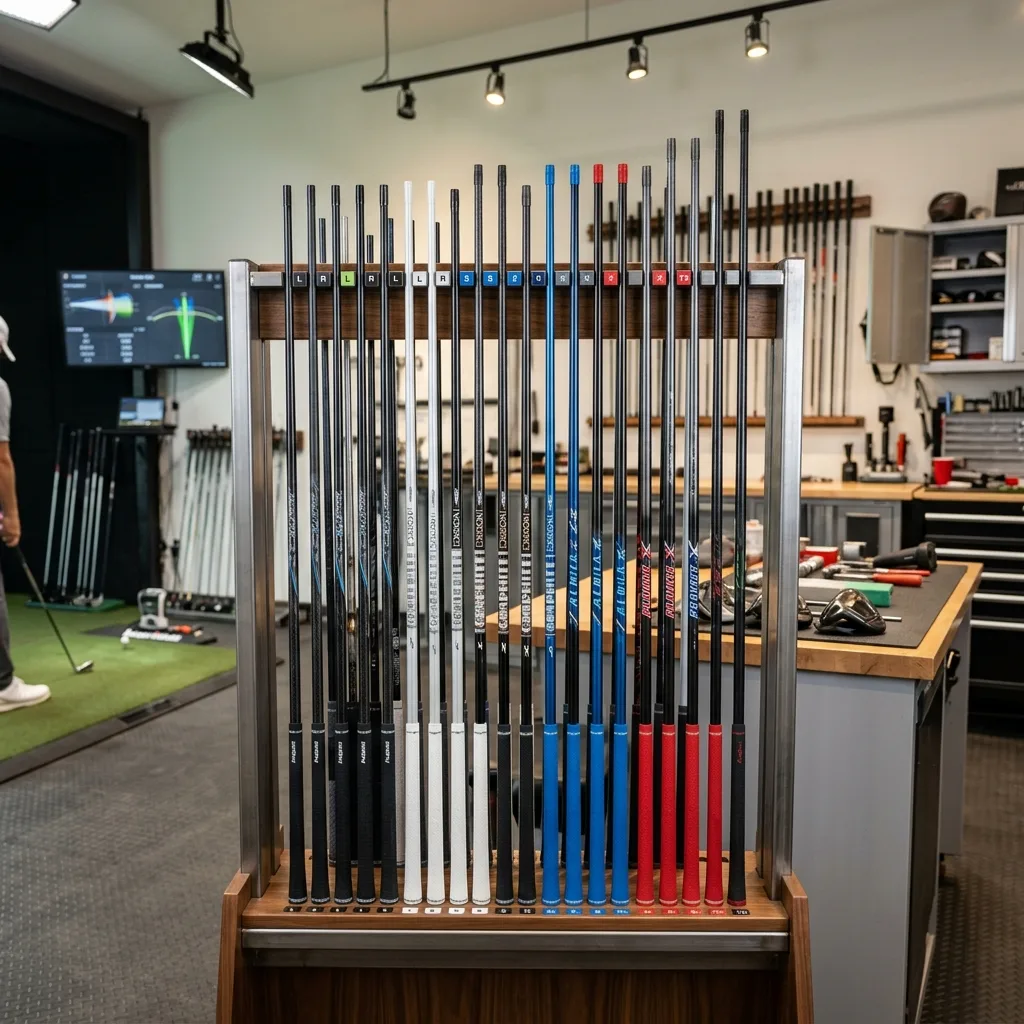
Understanding Shaft Mechanics: Flex, Torque, and Kick Point
The technical jargon surrounding modern golf shafts often confuses everyday recreational players. Let us break down the most important structural terms so you can make an informed purchasing decision.
The bend profile refers to exactly how and where the shaft bends during your dynamic golf swing. A critical component of this structural behavior is the kick point, which is the specific area of the shaft that flexes the most.
A low kick point helps get the golf ball airborne much more quickly. This characteristic is absolutely ideal if you typically struggle with low, descending drives that carry no distance.
On the other hand, a high kick point keeps the resulting ball flight incredibly penetrating and actively reduces excess spin, benefiting players who balloon their drives into the wind.
Another vital element in shaft mechanics is torque. Torque actively measures the shaft’s physical resistance to twisting during the violence of the downswing.
Lower torque ratings (generally anything under 3.5 degrees) feel substantially stiffer and resist twisting at very high speeds. This improves overall tip stability for aggressive swingers who put immense stress on the club.
Higher torque provides a much softer, more responsive feel and actively helps slower swingers square the club face at impact. When you intelligently combine the right kick point with the correct clubhead, you unlock maximum carry distance.
We previously discussed how loft affects launch angle, and your shaft’s kick point works directly in tandem with that specific loft to optimize your final trajectory.
How Your Tempo and Transition Affect Shaft Choice
Many amateur golfers falsely believe that swing speed is the sole factor in shaft selection. This is a massive misconception that leads to poor equipment choices. Your specific tempo and transition are equally important when determining the absolute right fit for your game.
Tempo (the overall rhythm and timing of your entire golf swing) and transition (the precise moment you change direction from the backswing to the downswing) dictate exactly how much stress you put on the golf shaft.
🟢 Smooth, Sweeping Tempo
If you possess a smooth, sweeping tempo similar to players like Ernie Els, you can often play a noticeably softer flex than your raw swing speed might technically suggest.
This smoother motion allows the shaft to load efficiently without inducing harsh, unwanted twisting at the tip.
⚡ Violent, Aggressive Transition
If you have a violent, aggressive transition—snatching the golf club down rapidly from the top of your swing—you need a significantly stiffer profile to handle that sudden, extreme force.
A shaft that is too weak for an aggressive transition will cause the spin rate to skyrocket unpredictably, ballooning the golf ball high into the wind and robbing you of precious roll-out distance upon landing.
Understanding your personal rhythm is the secret to unlocking consistent accuracy.

What is the best golf driver shaft for me? 5-Step Checklist
Answering the specific question of what profile fits your unique game best requires a highly methodical approach. Follow this comprehensive five-step checklist to dial in your equipment perfectly:
- Record Your Baselines Accurately: Use a reliable commercial launch monitor, such as a TrackMan or GCQuad, to capture your average swing speed and current smash factor over a series of twenty shots. Your smash factor (which is your ball speed divided by your swing speed) reveals exactly how efficiently you strike the center of the club face.
- Evaluate Your Most Common Miss: Do you consistently slice the ball out of bounds, hook it left, or hit it too low to carry hazards? Identifying your absolute most common miss dictates whether you need higher torque for face closure or a completely different kick point for optimal height.
- Analyze Your Unique Transition: Be brutally honest about your swing rhythm. Ask a friend to record your swing on a smartphone. A quick, jerky transition strictly requires a stiffer tip section for control, while a deliberate, relaxed pace benefits immensely from a more active profile that helps generate speed.
- Test Multiple Weight Categories: Try hitting a 50-gram, 60-gram, and 70-gram option side-by-side. The correct physical weight significantly improves your timing and actively helps you find the geometric center of the clubface much more often.
- Pair with the Right Driver Head: Even the absolute perfect premium shaft cannot fix an unforgiving, outdated clubhead. Make sure you intelligently match your new shaft with one of the best forgiving drivers available this year to maximize your overall results on the golf course.
Top 2026 Driver Shafts to Test (Fujikura, Mitsubishi, True Temper)
The 2026 golf equipment landscape introduces truly incredible advancements in carbon fiber layering techniques. We are seeing major manufacturers focus heavily on counterbalancing (strategically placing significantly more weight near the grip section) to properly accommodate the heavier, ultra-high-MOI driver heads released to the public this year.
Fujikura continues to thoroughly dominate the premium market with their acclaimed VENTUS TR line, featuring proprietary VeloCore+ technology. This unique multi-material construction maximizes tip stability under extreme loads, ensuring the clubface remains perfectly square even on devastating off-center strikes. If accuracy is your main issue, Fujikura offers unparalleled control.
Mitsubishi offers the highly respected Diamana series, which utilizes incredibly advanced resin systems and pitch fibers to provide an astonishingly smooth feel without ever sacrificing structural stability. They are the undisputed king of smooth profiles for moderate swingers.
Meanwhile, True Temper (specifically their high-performance Project X lineup) delivers exceptional, tour-proven options for aggressive swingers who desperately need to keep their launch conditions and spin numbers strictly under control. Testing these three specific heavyweights will give you a remarkably clear picture of exactly how modern engineering can tighten your shot dispersion.
The Driver Shaft Flex Myth: What Actually Matters
A surprisingly persistent myth in the amateur golfing community is that playing a noticeably stiffer shaft automatically makes you hit the golf ball farther and significantly straighter. We see countless recreational amateurs playing extra-stiff profiles simply to boost their ego on the first tee.
In stark reality, playing a shaft that is functionally too stiff for your specific mechanics utterly destroys your potential distance.
When a golf shaft is too rigid for your swing speed, it completely fails to load properly during the critical transition phase of the downswing. This severe lack of flex physically reduces your dynamic loft at impact, resulting in a dangerously low launch angle that falls quickly out of the sky without carrying very far.
Furthermore, a stiff shaft forces you to consciously swing much harder to try and generate artificial power. This over-swinging completely ruins your kinematic sequencing, throws you off balance, and plummets your smash factor to unplayable levels.
The ultimate goal is to play the most flexible shaft you can accurately control. A softer profile often generates a much higher launch, perfectly optimal spin, and genuinely effortless distance without requiring you to swing out of your shoes.
Should You Get a Professional Fitting or DIY?
Many dedicated players constantly wonder if paying top dollar for a professional fitting session is truly worth the upfront investment.
Building your own custom setup entirely through trial and error is certainly possible if you have unlimited access to a commercial launch monitor. However, buying multiple premium shafts simply to test on the driving range quickly becomes an incredibly expensive endeavor.
A certified professional fitter brings objective, hard data and an entirely unbiased eye to your golf swing. They have immediate access to literally thousands of unique head and shaft combinations that you could never source on your own.
More importantly, an experienced fitter knows exactly how to interpret the complex data. They look far beyond raw swing speed and closely analyze how your specific mechanics interact with vastly different bend profiles.
For the vast majority of amateur golfers, spending a few hundred dollars on a high-quality, comprehensive fitting session saves tremendous time. It eliminates endless frustration on the course and firmly guarantees that you walk away with the absolute optimal equipment specifically tailored for your game.
Conclusion: Upgrading Your Shaft vs. Buying a New Driver
Replacing a poorly fitted, outdated shaft is almost always a much smarter financial investment than spending big money on a completely new driver head every single season.
The oversized driver clubhead certainly provides the necessary forgiveness on mishits, but the shaft completely dictates the precise delivery, the resulting launch, and the overall feel of the shot.
By taking the time to match your swing mechanics perfectly to the correct profile, you instantly unlock hidden yardage that was previously unavailable to you. You will also drastically improve your fairways-hit percentage, lowering your scores in the process.
Take the required time to deeply understand your specific swing dynamics, test several different physical weights and flexes, and always trust the objective launch monitor data over your personal ego.
Below, we answer the most frequently asked questions that amateur golfers have when seriously evaluating their current equipment setups.
Frequently Asked Questions
What driver shaft should I use for a 90 mph swing speed?
For a 90 mph swing speed, a regular flex shaft is typically the best choice. This specific flex naturally helps maximize your overall distance and launch angle without requiring excessive physical swing effort. It perfectly balances necessary control with maximum available power.
Does changing my driver shaft really make a difference?
Yes, changing your driver shaft can significantly and immediately impact your on-course performance. The absolute right shaft perfectly optimizes your specific launch angle, ideal spin rate, and shot dispersion. This naturally leads to noticeably longer, considerably straighter drives. Upgrading the shaft is very often better than simply buying a new driver.
What is the kick point on a golf shaft?
The kick point is the specific section of the golf shaft that physically bends the most during your dynamic swing. A remarkably lower kick point intentionally produces a much higher launch angle, while a notably high kick point consistently delivers a much lower, aggressively penetrating ball flight.
Should I play a stiffer shaft in my driver?
You should genuinely only play a stiffer shaft if your absolute swing speed and aggressive downswing transition truly demand it. A shaft that is significantly too stiff will inevitably result in a lower launch, far less spin, and a massive loss of carry distance. It also very often causes uncontrollable slices.
How important is shaft torque?
Shaft torque actively measures the physical resistance to twisting during the violent motion of the swing. Lower torque universally feels stiffer and is substantially better for players with high swing speeds. Conversely, higher torque offers a much softer feel, actively helping to square the clubface effectively for players with slower, much smoother swings.
Get our latest guides, news, and insights highlighted in your Google Search & AI Overviews.