
When searching for the best disc golf driver for beginners, many new players step up to the tee pad with a massive rimmed Distance Driver. They throw it as hard as humanly possible. The disc instantly crashes into the ground just fifty feet away.
This exact scenario plays out on local courses every single day. New players ruin their form trying to force heavy plastic down the fairway. They get deeply frustrated by their lack of progress.
They assume they simply lack the physical strength to throw far. But physical strength has almost nothing to do with driving distance. Your technique and your disc selection dictate your ultimate potential.
You can easily double your driving distance by making one simple equipment swap. And the solution involves a disc characteristic that most players completely ignore.
Table of Contents
- What is the Best Disc Golf Driver for Beginners?
- The Speed Trap: Why Beginners Shouldn’t Throw Distance Drivers
- Understanding Flight Ratings for Beginner Drivers
- Our Top Understable Fairway Driver Picks
- How to Match a Disc to Your Current Arm Speed
- The Impact of Plastic Types and Disc Weight
- How to Throw a Hyzer Flip for Extra Distance
- Ready to Upgrade to the Best Disc Golf Driver for Beginners?
- Frequently Asked Questions
What is the Best Disc Golf Driver for Beginners?
The best disc golf driver for beginners is an Understable Fairway Driver. You do not need a massive rim to throw far. You need a disc that works with your current physical capabilities.
An understable disc naturally wants to turn to the right during flight. We assume a backhand throw by a right-handed player. This rightward turning characteristic keeps the disc in the air significantly longer.
It directly prevents that dreaded early crash to the left side. We highly recommend starting with the Latitude 64 Diamond. This specific mold caters perfectly to newer players developing their technique.
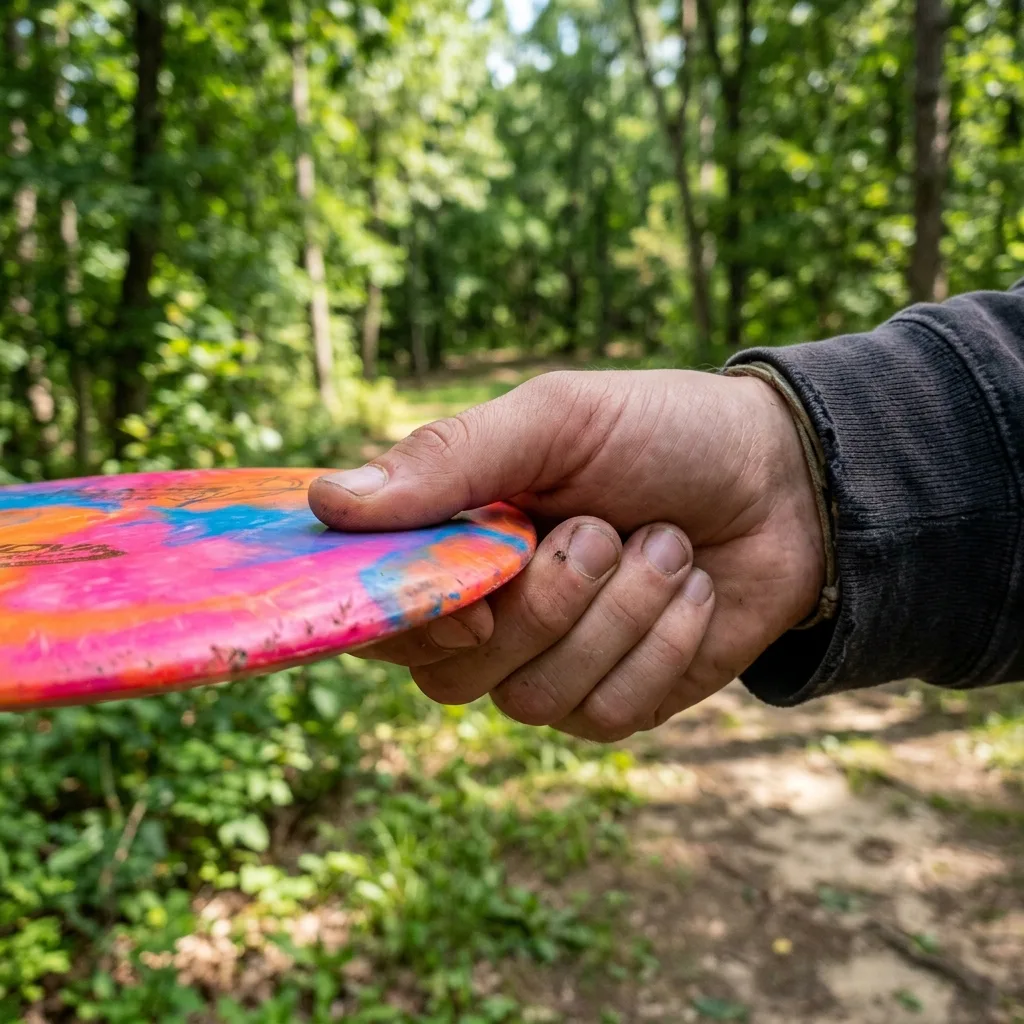
It features a lightweight design and a very comfortable rim width. You can easily get your fingers completely around the rim. A proper grip gives you much better control over your release angle.
Grip confidence translates directly into massive distance down the fairway. To fully grasp why this works, you must master disc mechanics. Before you buy another disc, we strongly recommend understanding disc golf flight numbers.
These four numbers stamped on the top tell the entire story. They dictate exactly how the plastic will behave in the air. Learning these numbers prevents you from making expensive mistakes at the store.

The Speed Trap: Why Beginners Shouldn’t Throw Distance Drivers
Manufacturers aggressively market their high-speed discs to experienced, powerful throwers. Beginners see touring professionals throwing these discs over five hundred feet. They assume buying the same disc will yield the exact same result.
This faulty logic creates a massive trap for eager amateurs. A Distance Driver demands incredible Arm Speed to fly correctly. You must generate immense rotational force to keep the disc flat.
When a beginner throws a 12-speed disc, they lack the necessary Snap. The disc never reaches its intended aerodynamic cruising speed. Physics takes over immediately upon release from your hand.
The disc experiences severe, premature Fade. It violently hooks to the left and hits the ground hard. You end up deep in the woods instead of landing safely in the fairway.
Throwing discs that are too fast actively destroys your Form. You subconsciously start rounding your reach-back to force the disc right. You lean back excessively during your throw to add height.
You develop terrible habits that take years to properly unlearn. Stepping down to a slower disc forces you to focus on smooth mechanics. You learn how to properly shift your weight forward.
Understanding Flight Ratings for Beginner Drivers
Every modern disc features a four-number Flight Ratings system. These numbers represent Speed, Glide, Turn, and Fade. Speed is the first number printed on the top of the disc.
It dictates how fast you must throw to achieve the intended flight. Beginners should never exceed a speed rating of 9. Slower discs require far less physical effort to fly correctly.
The second number represents Glide. This specifically measures the disc’s ability to stay aloft. Beginners absolutely need High Glide for maximum distance off the tee.
Look for a glide rating of 4, 5, or even 6. A high-glide disc actively fights gravity during the entire flight path. It effortlessly carries further down the fairway even with a weaker throw.
Glide provides free distance for developing players who lack explosive power. The third number is Turn. You want a Negative Turn rating on your early drivers.
A rating of -2 or -3 is absolutely perfect for new players. Negative turn helps the disc fight its natural urge to fall left. The final number is Fade.
Beginners need Minimal Fade to keep their tee shots straight. A fade rating of 1 or 2 ensures a gentle, forward-penetrating finish. High fade ratings will punish any throw lacking proper velocity.
Our Top Understable Fairway Driver Picks
We rigorously tested dozens of molds to find the best options. The Innova Leopard stands as the undisputed champion of starter drivers. It features a speed rating of 6 and a forgiving flight.
The Leopard teaches you how to throw a perfectly straight line. It rewards a smooth release with laser-straight flights through tight woods. Every beginner should own at least one Leopard in their bag.
Once you master the Leopard, step up to a Control Driver. The Innova Valkyrie serves as the perfect transition disc. It bumps the speed up to 9 for extra distance potential.
The Valkyrie still offers plenty of turn for developing players. Former world distance records were actually set using the Valkyrie mold. It proves you do not need maximum speed for massive distance.
We also heavily endorse the incredibly popular Axiom Crave. The Crave offers a remarkably straight flight with a subtle finish. Its dual-mold overmold technology provides excellent durability on heavily wooded courses.
The flat profile feels fantastic in both small and large hands. You can confidently throw the Crave on almost any hole shape. It remains a staple in beginner and professional bags alike.
How to Match a Disc to Your Current Arm Speed
You must honestly evaluate your current throwing capabilities and distance. Grab a Midrange disc and head to a large open field. Throw it as far as you can using a flat, smooth release.
Measure your average distance over a dedicated set of ten throws. If you cannot throw a midrange past two hundred feet, stop right there. You are not ready for any type of driver yet.
Once your midrange consistently passes the two-hundred-foot mark, upgrade your speed. Do not rush this progression under any circumstances. Bumping up your speed rating too quickly will stall your athletic development.
You will instinctively start compensating for the early fade. You will lose all the clean mechanics you just spent weeks building. Patience yields massive long-term rewards in the sport of disc golf.
Your short game matters just as much as your powerful drives. A massive drive means absolutely nothing if you miss your putt. You need a highly reliable putter to finish every single hole.
Finding the right putter takes extensive experimentation and focused practice sessions. You should definitely explore the best putters to pair with your new driver. A cohesive bag setup will drastically lower your scores.
The Impact of Plastic Types and Disc Weight
Plastic Types
Manufacturers produce the exact same mold in several different plastic blends. Premium plastics look beautiful and survive tree hits without taking damage. However, premium plastics inherently fly much more overstable than base plastics.
A brand new premium driver will fight to the ground immediately. Beginners should exclusively start with base plastics for their first drivers. Base plastics break in quickly and achieve the desired flight path faster.
Disc Weight
Weight plays a monumental role in overall disc performance and stability. Most professional drivers weigh between 165 and 175 grams. Beginners should seek out discs weighing 150 to 160 grams instead.
Lighter discs require significantly less physical force to accelerate properly. You can generate higher release velocities with much less physical effort. Higher velocity translates directly to longer, straighter flights down the fairway.
Do not let ego dictate your disc weight selection on the course. Many advanced players transition back to lighter weights as they age. A 150-gram driver will easily out-fly a max-weight driver in a tailwind. Keep a lightweight option in your bag for calm days. You will be amazed by the effortless distance it consistently provides you. It saves your arm from fatigue during a long tournament.
How to Throw a Hyzer Flip for Extra Distance
The Hyzer Flip stands as the most valuable shot for new players. This technique allows you to throw incredibly far with minimal effort. You start by gripping a highly understable fairway driver.
You release the disc on a severe downward hyzer angle. The left side of the disc points sharply down toward the ground. Because the disc is highly understable, it fights out of the angle.
The disc flips up to a perfectly flat orientation mid-flight. It then glides forward for a massive distance before finishing straight. This specific shot shape maximizes the glide phase of the flight.
If you want to unlock serious distance, you must learn how to throw a hyzer flip. Mastering the hyzer flip requires diligent, focused field work. You cannot reliably learn this shot during a casual weekend round.
Take your understable fairway drivers to an empty local soccer field. Focus entirely on your release angle and follow-through plane. Try to keep your wrist strictly locked on the downward hyzer plane.
Let the understable nature of the disc do the work. It will naturally flip flat if you supply enough smooth spin. This shot will completely transform your performance on long wooded holes.
Ready to Upgrade to the Best Disc Golf Driver for Beginners?
Finding the right equipment changes everything about your disc golf game. You will stop dreading those long, intimidating par four tee shots. You will start attacking the basket with newfound confidence and accuracy.
The game becomes exponentially more fun when discs fly correctly. Leave the ultra-fast, max-speed plastic at home for now. Embrace the control and effortless glide of a slower, understable disc.
Your throwing form will naturally improve as you utilize appropriate speeds. You will stop masking technique flaws with overly stable premium plastic. You will learn to control release angles and proper weight transfer.
These foundational skills are mandatory for long-term improvement and distance growth. You cannot buy a better golf game overnight. You can certainly buy the right tools to build one properly.
Check out our top recommended beginner drivers in the store. Grab a lightweight, understable fairway option for your next round. Head to your local course and experience the massive difference immediately.
The fairways will feel wider than they ever have before. The distant baskets will finally feel reachable off the tee. Your journey to better disc golf starts with the right driver.
Frequently Asked Questions
What is the best disc golf driver for a complete beginner?
The best disc golf driver for a complete beginner is an understable fairway driver with a speed rating of 7 to 9. Discs like the Latitude 64 Diamond or Innova Leopard are highly recommended because they compensate for lower arm speeds.
Why shouldn’t beginners use distance drivers?
Beginners typically lack the arm speed and snap required to keep high-speed distance drivers flying flat. This causes the disc to fade out early, resulting in shorter throws and poor form habits. Stick to fairway drivers to build correct technique.
What flight ratings are best for beginner drivers?
Beginners should look for drivers with a speed between 6 and 9, high glide (4+), negative turn (-2 or -3), and minimal fade (1 or 2). This combination ensures the disc stays straight longer for those with slower arm speeds.
What is the difference between a fairway driver and a distance driver?
Fairway drivers have thinner rims and lower speed ratings, making them easier to grip and control. Distance drivers have wide rims and require much higher arm speeds to achieve their intended flight paths, which can be frustrating for new players.
Should a beginner throw an understable or overstable driver?
Beginners should always start with an understable driver. Understable discs have a natural tendency to turn right for a right-handed backhand throw, which perfectly counteracts the early fade that new players often experience, resulting in straighter, longer drives.
Get our latest guides, news, and insights highlighted in your Google Search & AI Overviews.