
✨ This article was AI edited. Editorial responsibility: GolfGearDirect.blog.
If you watch the PGA Tour, where players regularly launch the ball past 300 yards, this number might sound incredibly low.
However, the reality of recreational golf is vastly different than professional television broadcasts.
Every weekend, an amateur male golfer steps up to the tee box expecting to crush the ball. They buy the latest equipment and watch endless instructional videos on YouTube.
They see the new PGA Tour driver length rules and assume that modern technology guarantees massive distance for everyone.
Yet, the data from shot-tracking platforms like Arccos paints a completely different picture of weekend golf.
We analyzed the numbers across various skill levels and age groups. We found that most players are leaving massive yardage on the table due to poor swing mechanics.
There is one specific mechanical flaw that costs the average player up to 30 yards per drive.
The secret to unlocking that distance is hidden in a single data point most players never check.
Table of Contents
- What Is The True Average Drive For Male Golfer?
- Average Drive For Male Golfer by Age Bracket and Handicap Range
- How Swing Speed and Smash Factor Actually Affect Your Distance
- 3 Proven Steps to Increase Your Clubhead Speed and Attack Angle
- Optimizing Your Equipment: Driver Loft and Shaft Flex
- Expectations vs Reality: Why Amateurs Struggle With Distance
- Does a More Forgiving Driver Actually Add Distance for a Senior Golfer?
- Summary: Stop Chasing 300 Yards and Optimize Your Unique Swing
- Frequently Asked Questions
What Is The True Average Drive For Male Golfer?
When we look at the raw statistics, the baseline average drive for male golfer hovers near the 215-yard mark.
This number accounts for total distance, which includes both carry and roll on the fairway.
Many players drastically overestimate their capabilities because they only remember their absolute best shots on the golf course. They forget the toe-hooks and sky-balls that drag down their true statistical average.
Understanding your baseline is the first crucial step toward genuine improvement. If you rely on guessing, you cannot track your progress accurately over time.
A mid-handicap player might hit one drive 260 yards, but their next three drives might only travel 190 yards. The mathematics of average distance demand consistency over pure peak power, which is why accurate tracking is essential.
Your age bracket plays a significant role in your potential distance off the tee.
A 30-year-old player will naturally generate more rotational force than a 60-year-old player. However, raw physical power is only a fraction of the complex golf equation.
We regularly see older players consistently outdriving younger opponents simply because they strike the ball more efficiently.
The data proves that mechanics outweigh brute strength almost every single time.
Hitting the ball 250 yards requires solid contact, not just a violent swing. Golf is fundamentally a game of precision rather than sheer force.
Mastering the fundamentals always yields better results on the scorecard.
In the next section, we break down exactly how these numbers shift across different demographics and skill levels.

Average Drive For Male Golfer by Age Bracket and Handicap Range
To truly understand where you stand, we must categorize the data by age bracket and handicap range.
A scratch golfer and a 20-handicap player have vastly different impact dynamics at the moment of truth.
The data clearly shows that as your handicap drops, your driving distance reliably and predictably increases.
We need to look closely at these demographic shifts to set realistic expectations for your game. Let us look at the average distances based on age groupings first.
Players in their twenties average around 238 yards off the tee, utilizing their peak physical flexibility.
Golfers in their thirties see a slight drop to roughly 231 yards as they play slightly less frequently. By the time players reach their forties, the average settles near 225 yards, requiring better technique to maintain distance.
The decline continues predictably as players enter their fifties, averaging 215 yards overall.
A senior golfer in their sixties typically hits it about 204 yards, relying heavily on course management.
Finally, players aged seventy and above average around 190 yards. Notice the steady decline as players get older and naturally lose physical elasticity and rotational speed.
However, aging does not mean you have to surrender your distance entirely on the golf course.
Now, let us examine how skill level impacts these numbers across the board. When we look at handicap range, the correlation to distance is absolutely undeniable and fascinating.
Scratch golfers hit the ball 250 yards or more on average, maximizing their potential on every swing.
Players with a 1 to 5 handicap average a very respectable 240 yards, keeping them highly competitive.
A mid-handicapper in the 11 to 15 range averages 220 yards, which is plenty of distance to score well.
Players with a handicap over 21 average roughly 195 yards, primarily due to inconsistent ball striking.
Lower handicap players hit the ball further because they deliver the clubface to the ball consistently.
They minimize glancing blows and optimize their launch conditions perfectly on almost every drive.
If you want to increase your distance, you must start by improving your contact quality rather than swinging harder.
How Swing Speed and Smash Factor Actually Affect Your Distance
Two primary metrics dictate your total distance on any given shot off the tee box. The first is your swing speed, and the second is your smash factor.
Your clubhead speed measures how fast the driver head is moving right before impact.
This number represents your raw power potential and is the engine driving the golf ball forward.
The average recreational player swings the driver at roughly 93 miles per hour. However, speed alone means absolutely nothing without efficiency at impact.
Smash factor is the ratio of ball speed divided by clubhead speed. It measures how effectively you transfer energy from the clubface to the golf ball during the collision.
A perfect center strike with a driver yields a smash factor of 1.50.
If you swing at 100 mph with a perfect 1.50 smash factor, your ball speed hits 150 mph.
This typically results in a drive of about 270 yards, maximizing your effort completely. Every incremental drop in this ratio means you are wasting energy and losing valuable yards.
But if you swing at 100 mph and hit it off the toe, your smash factor drops to 1.35.
Your ball speed plummets to 135 mph, resulting in a drive of only 230 yards. You lost 40 yards without losing a single mph of clubhead speed on that swing.
This explains why the guy in your weekend foursome who swings smoothly often outdrives the guy swinging wildly.
Efficiency always beats raw, uncontrolled power on the golf course.
To maximize your distance, you must focus on center-face contact before you ever try to swing faster.
Chasing speed without solid contact is a recipe for poor results.
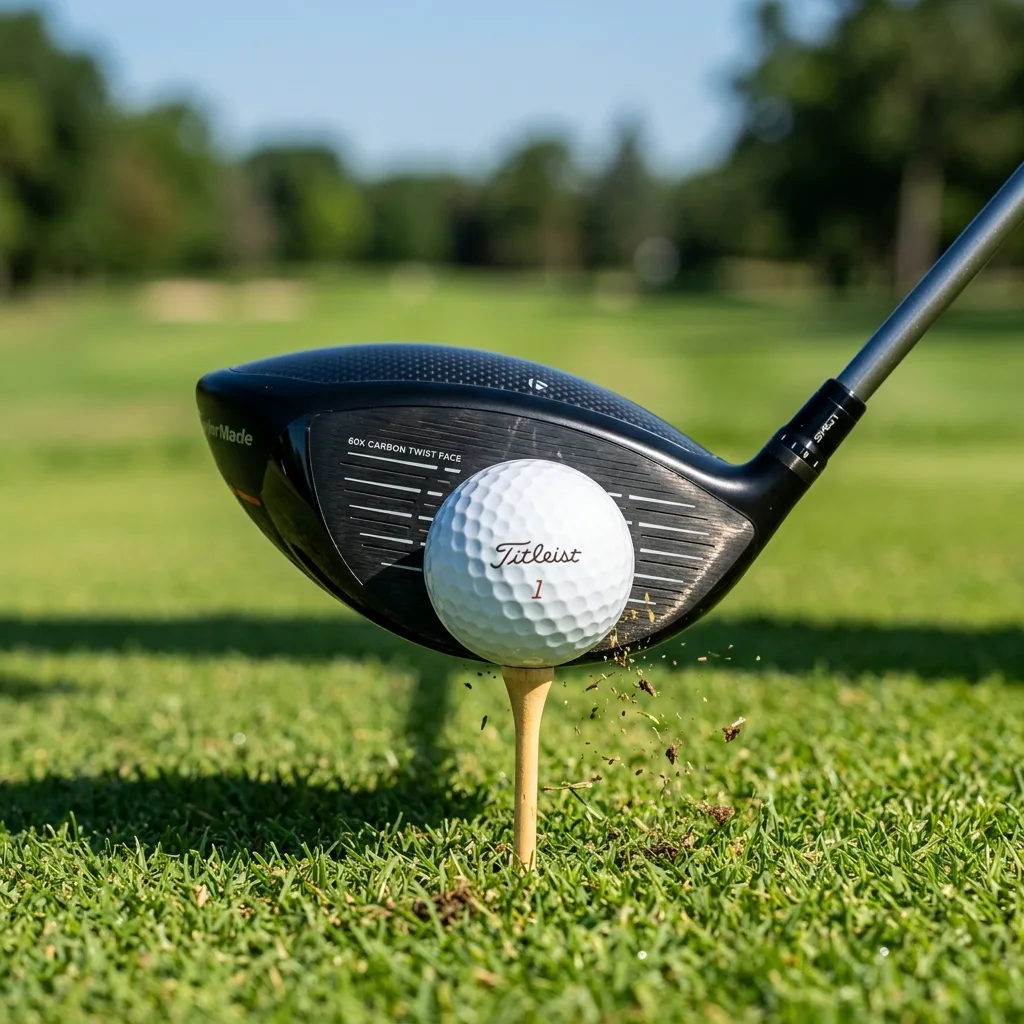
3 Proven Steps to Increase Your Clubhead Speed and Attack Angle
If you want to hit longer drives, you need to optimize your attack angle immediately.
The attack angle refers to whether the clubhead is traveling up or down as it strikes the ball.
Most amateurs hit down on their driver with a negative attack angle, treating it like an iron shot. This increases spin and robs you of massive distance on every single tee shot.
To hit bombs, you must hit up on the ball consistently. A positive attack angle launches the ball higher with significantly less spin, creating a penetrating ball flight.
Here are three proven steps to achieve this upward strike instantly and add effortless yards to your drives.
First, you must adjust your setup and ball position on the tee. Move the golf ball forward in your stance, ideally opposite your lead heel.
Tilt your spine slightly away from the target at address, dropping your trail shoulder slightly. This pre-sets your body to deliver the clubhead on an upward trajectory through the hitting zone.
Second, you need to tee the ball higher than normal to encourage a sweeping motion.
You cannot hit up on the ball if it is teed too low into the ground. Ensure that at least half of the golf ball sits above the crown of your driver.
This encourages you to sweep the ball off the tee rather than chopping down on it abruptly.
Third, you must learn to square the Clubface early in the downswing to ensure optimal energy transfer.
Many players leave the clubface open, resulting in weak slices that lose distance and find the rough.
Focus on rotating your lead wrist so the logo of your glove points toward the target at impact. A square face combined with an upward strike maximizes your energy transfer and ball speed.
Optimizing Your Equipment: Driver Loft and Shaft Flex
Your equipment must precisely match your unique swing characteristics to maximize your potential. Playing the wrong specifications will sabotage even the best mechanics and cost you significant yardage.
Two of the most critical factors in optimizing your gear are your driver loft and your shaft flex. Finding the perfect combination requires testing and understanding your personal delivery numbers.
Driver Loft
Most amateurs play too little loft off the tee because of ego. They buy 9-degree drivers simply because that is what the professionals use on television every weekend.
However, professionals swing at 115+ mph and actually need lower loft to control their spin and trajectory.
An amateur swinging at 90 mph with a 9-degree driver will hit weak, low-flying shots that plunge quickly. The average player needs much more driver loft to achieve an optimal launch angle.
Moving from a 9-degree to a 10.5-degree or even a 12-degree driver can instantly add carry distance.
A higher launch angle keeps the ball in the air longer, maximizing your total yardage on every drive. Do not be afraid of a higher lofted club if the launch monitor proves it adds distance.
Shaft Flex
Shaft flex is equally important for optimizing your ball flight and consistency. If your shaft is too stiff, you will struggle to square the face and launch the ball high enough.
If it is too flexible, you might struggle with a very wide shot dispersion and ballooning trajectories.
You need a shaft flex that loads and unloads properly for your specific clubhead speed and transition aggressiveness.
If you are serious about upgrading, you must find a driver for distance that fits your profile.
A proper fitting will identify the exact combination of loft and flex you need to succeed. Do not guess with your equipment; let the launch monitor data guide your purchasing decisions entirely.
Expectations vs Reality: Why Amateurs Struggle With Distance
Golfers are constantly bombarded with aggressive marketing promises from major equipment manufacturers.
Every single year, companies release new golf drivers claiming to add 10 to 15 yards to your game automatically.
While modern technology is incredible, it simply cannot fix a fundamentally flawed swing or poor impact conditions.
You cannot buy a better swing, but you can certainly optimize what you have.
The biggest gap between expectation and reality comes from watching television broadcasts. Watching touring professionals effortlessly carry the ball 300 yards warps our perception of what is actually normal.
We expect to hit those numbers, and we get intensely frustrated when we inevitably fall short on the course. This misplaced expectation ruins rounds and creates unnecessary mental pressure on the tee box.
This frustration inevitably leads to swinging harder in a desperate attempt to find more yards.
Swinging harder degrades contact quality and actually reduces your overall distance on most attempts. Amateurs struggle because they chase speed at the expense of sound mechanics and balance.
They lunge at the ball, lose their balance completely, and strike it all over the clubface.
The reality is that a smooth, balanced swing will almost always produce a longer drive.
Golf is a fascinating game of opposites; sometimes you literally have to swing easier to hit it further.
We must accept our current capabilities and build intelligently from there, focusing on center contact above all else.
Finding the middle of the clubface consistently is the ultimate secret to unlocking your true distance potential.
Track your actual on-course distances accurately with GPS or laser rangefinders over multiple rounds. Once you know your true averages, you can set realistic goals for your improvement journey.
Formulate a structured plan to improve them incrementally rather than searching for overnight miracles that do not exist.
Does a More Forgiving Driver Actually Add Distance for a Senior Golfer?
As we age, our physical capabilities inevitably change and adapt over time. A senior player often faces a natural and gradual reduction in swing velocity and overall flexibility.
This is precisely where modern golf club technology truly shines and offers a massive advantage.
Engineering advancements have made it possible to retain performance even when the body slows down slightly. Upgrading to a highly forgiving driver is the most effective way for an older player to maintain their distance.
A forgiving club features a high Moment of Inertia, commonly known as MOI within the industry.
This means the clubhead resists twisting when you strike the ball off-center, maintaining stability through the hitting zone. Stability equals better energy transfer, even on your worst swings of the day.
When you hit a drive off the toe or heel with an older, less forgiving club, the face twists violently.
This kills your ball speed immediately and causes the ball to curve wildly off target into the rough.
High MOI drivers stabilize the face on those exact mishits, saving you from disastrous results. The technology essentially widens the sweet spot, giving you a larger margin for error on every tee shot.
You preserve much more of your ball speed, meaning your bad shots still travel a respectable distance down the fairway.
For a player who struggles to find the dead center of the face consistently, this technology is absolutely invaluable.
It tightens your dispersion, keeps you safely in the fairway, and lowers your scores.
A forgiving driver acts as a safety net against poor swings. So yes, forgiveness directly equates to retained distance on the golf course.
By raising the floor on your worst shots, your overall average distance increases significantly over a full round.
It is undeniably the smartest investment an aging player can make in their golf game today.
Summary: Stop Chasing 300 Yards and Optimize Your Unique Swing
The obsession with hitting 300-yard drives ruins more scorecards than it ever helps.
The data clearly shows that the average male player hits it closer to 215 yards on a normal day.
Once you accept this reality, you can finally stop swinging out of your shoes and focus on playing smart.
Managing your expectations is the first step toward shooting lower scores and enjoying the game more.
Start playing strategic golf and manage your way around the course intelligently from tee to green.
Focus your energy entirely on improving your smash factor and achieving a positive attack angle with the driver.
These mechanical adjustments yield far better results than simply trying to swing faster without control.
Efficiency will always produce better outcomes than raw, unrefined power.
Ensure your equipment—specifically your loft and shaft flex—is optimized for your current speed and delivery.
Do not buy clubs based on your dream speed or what your favorite professional plays on tour.
Every player has a unique swing signature that requires a tailored approach to equipment fitting.
Working with a professional fitter can unlock hidden yardage you never knew you had.
Your goal is not to swing exactly like a tour professional on television. Your goal is to maximize the efficiency of your own natural motion and deliver the clubhead squarely.
Track your stats, understand your baseline, and work diligently on making solid contact every single time you swing.
Consistent contact is the hallmark of a great driver of the golf ball.
The distance will naturally follow once you prioritize efficiency and mechanics.
Stop comparing yourself to the outliers and start focusing on your own personal progress week after week.
The game becomes much more enjoyable when you play within yourself and maximize what you have in your bag.
Frequently Asked Questions
What is the average drive for a 50-year-old male golfer?
The average drive for a 50-year-old amateur male golfer is typically around 210 to 220 yards. This distance can vary based on fitness, flexibility, and equipment, but as golfers age, focusing on smash factor and a forgiving driver becomes crucial to maintain distance.
How does swing speed affect driving distance?
Swing speed directly correlates with driving distance. For every 1 mph increase in clubhead speed, you can gain roughly 2.5 to 3 yards of distance, assuming an optimal launch angle and smash factor on your strike.
What is a good smash factor for a driver?
A perfect smash factor with a driver is 1.50, meaning the ball speed is 1.5 times the clubhead speed. Most amateur male golfers average around 1.40. Improving center contact will raise your smash factor and instantly add yards without swinging harder.
Does shaft flex impact driving distance?
Yes, using the wrong shaft flex can hurt your distance. If the shaft is too stiff, you might struggle to launch the ball high enough. If it’s too flexible, your dispersion widens. Matching shaft flex to your swing speed optimizes your launch angle and spin.
Should a senior golfer use a more forgiving driver?
Absolutely. A forgiving driver helps maintain ball speed on off-center hits. For a senior golfer experiencing a slight dip in clubhead speed, maximizing distance on mis-hits is the easiest way to keep your average drive competitive on the course.
Get our latest guides, news, and insights highlighted in your Google Search & AI Overviews.