
✨ This article was AI edited. Editorial responsibility: GolfGearDirect.blog.
The true average drive for amateur golfer sits right around 220 yards, falling far short of the mythical 250-yard benchmark most players claim to hit.
We analyzed the latest 2026 Arccos data and USGA reports, discovering that distance off the tee is declining for many weekend warriors due to new equipment regulations and a misunderstanding of swing mechanics. Many players step up to the tee box swinging out of their shoes, expecting professional-level carry, only to slice the ball into the woods.
But distance isn’t just about swinging harder. Your grip, your stance, and your equipment all play massive roles. We tested hundreds of swings across different demographics to see what actually works.
Yet, there is one specific metric that almost everyone ignores, determining whether your drive stays on the fairway or ends up 30 yards right. And that crucial detail is revealed in the next section.
Table of Contents
- What Is the Real average drive for amateur golfer?
- Average drive for amateur golfer by Age Bracket and Handicap Level
- How Clubhead Speed and Smash Factor Impact Your Drive
- How to Safely Increase Your Swing Speed Without Losing Accuracy
- 3 Proven Drills to Boost Your Performance Average
- The 250-Yard Myth: Why Distance Dispersion Matters More
- Do New Launch Monitors and Drivers Actually Help?
- Stop Chasing Yardage, Start Chasing Consistency
- Frequently Asked Questions
What Is the Real average drive for amateur golfer?
When we look at millions of shots recorded by Arccos and Shot Scope tracking systems, the reality check hits hard. The actual average drive for amateur golfer is not 250, 260, or 280 yards.
The data confirms that a typical male weekend player carries the ball around 215 yards, with a total rollout bringing the performance average to about 220 to 225 yards.
Why do golfers constantly overestimate their distances? Usually, players remember their absolute best drive of the year—the one where the wind was howling at their back, hitting a downslope on a firm fairway—and they anchor their expectations to that anomaly.
A launch monitor will quickly humble you, revealing that your actual performance average includes those off-center strikes, pop-ups, and low hooks.
Shot Scope reveals that only a tiny fraction of everyday players legitimately average over 250 yards over the course of a full season. This gap between expectation and reality causes significant course management issues.
If you plan your approach shots based on a 250-yard drive but only hit it 220, you leave yourself much longer second shots than anticipated. Understanding your true numbers is the first step toward shooting lower scores.

Average drive for amateur golfer by Age Bracket and Handicap Level
To truly understand driving distance, we must break down the numbers by age bracket and handicap level. A 25-year-old scratch golfer will naturally produce very different numbers than a 65-year-old mid-handicapper. The tracking data provides a fascinating look into how these demographics shape our expectations.
By Handicap Level
Let’s look at the handicap level first. A scratch golfer (0 handicap) typically averages around 240 to 245 yards off the tee. These players have highly refined mechanics, delivering the clubhead squarely and efficiently.
As the Handicap rises, distance drops significantly. A 10-handicap player averages around 225 yards, while a 20-handicap golfer drops closer to 200 yards. This linear relationship proves that technique and center contact matter just as much, if not more, than raw physical strength.
By Age Bracket & Gender
When we examine the data by age bracket, the decline is exactly what you would expect. Golfers in their 20s and 30s peak in their driving distance, averaging around 230 yards. As players enter their 50s, flexibility and fast-twitch muscle fibers diminish.
A typical senior golfer over the age of 60 averages around 195 to 205 yards. For these players, optimizing launch conditions is far more critical than trying to swing harder.
The statistics for a female amateur show a similar pattern, averaging around 145 to 150 yards. However, optimizing shaft weight and launch angles often yields massive gains—sometimes 20 to 30 yards.
How Clubhead Speed and Smash Factor Impact Your Drive
The physics of a golf drive ultimately come down to two primary metrics: Clubhead Speed and Smash Factor. You cannot maximize your distance without understanding how these two elements interact at the moment of impact.
Clubhead speed (or swing speed) is the absolute velocity of the clubhead just before it strikes the golf ball. The average male amateur generates a swing speed of roughly 93 miles per hour.
For every one mph of clubhead speed, you can theoretically generate about 2.5 to 2.7 yards of total distance. If you want to hit the ball further, swinging faster is the most obvious solution.
However, swinging faster only works if you maintain your Smash Factor. Smash factor is the ratio between ball speed and clubhead speed. It measures how efficiently energy is transferred from the club to the ball.
A perfect smash factor with a driver is 1.50. If you swing at 100 mph and hit the ball perfectly out of the center of the face, your ball speed will be 150 mph.
Many amateurs try to increase their swing speed but end up making poor contact, hitting the ball off the toe or heel. This drops the smash factor down to 1.35 or lower.
You can actually swing five miles per hour slower, hit the sweet spot, achieve a higher smash factor, and drive the ball significantly further. The next time you step onto a Launch Monitor, stop obsessing solely over your swing speed and start paying close attention to your smash factor. Center contact remains the undisputed king of distance.
How to Safely Increase Your Swing Speed Without Losing Accuracy
Gaining speed safely requires a methodical approach. You cannot simply step up to the ball and swing out of your shoes; that only leads to pulled muscles and lost golf balls. Instead, you need to focus on biomechanics, flexibility, and proper equipment alignment.
First, focus on your physical mobility. Golf requires explosive rotational power, which stems from the hips and thoracic spine. Incorporating a daily stretching routine tailored for golfers can increase your range of motion, allowing you to generate a wider arc.
A wider arc naturally produces more speed at the bottom of the swing without requiring additional muscular effort. Second, consider overspeed training. Systems utilizing weighted sticks can trick your nervous system into moving faster.
By swinging clubs that are slightly lighter and slightly heavier than your standard driver, you build fast-twitch muscle memory. Doing this just three times a week can add 4 to 6 mph to your swing speed in a matter of months.
Finally, ensure your equipment matches your newly acquired speed. Not all golf drivers are built the same.
If your shaft is too flexible, increased speed will lead to wild dispersion. Conversely, if your shaft is too stiff, you will struggle to launch the ball high enough.
Upgrading to a specialized driver for distance with the correct loft and shaft profile will instantly optimize your launch conditions. This ensures that your faster swing actually translates into more yardage on the course.
3 Proven Drills to Boost Your Performance Average
Knowing the theory behind distance is great, but applying it on the driving range is where the real work happens. If you want to elevate your performance average and consistently hit the ball further, integrate these three drills into your practice routine.
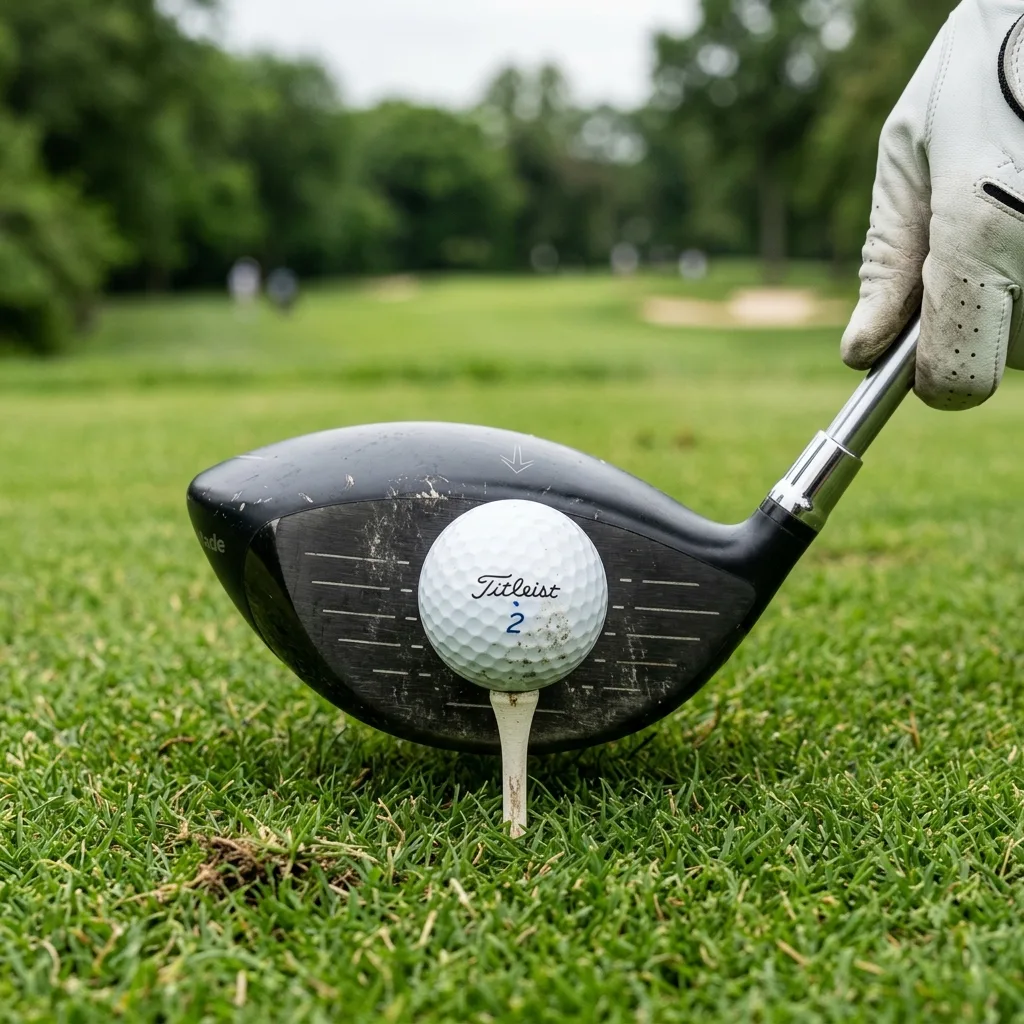
1. The Foot Spray Drill: Buy a cheap can of aerosol foot powder spray and coat the face of your driver. Hit five golf balls. The powder will clearly show exactly where you are making contact.
If your strike marks are scattered all over the face, you must dial back your effort level until you can consistently find the center. This drill provides instant visual feedback to improve your smash factor.
2. The Step-Through Drill: To generate maximum power, you must shift your weight properly from your trail leg to your lead leg. Address the ball normally, but as you swing down, physically step forward with your trail foot toward the target.
This resembles a baseball player hitting a home run. This forces your body to transfer its mass through the ball. It prevents the common amateur flaw of falling backward at impact.
3. The Tee-High Drill: Most amateurs hit down on the golf ball with their driver, creating excessive backspin that robs them of distance. To promote a positive angle of attack, tee the ball significantly higher than normal.
Place a headcover about a foot in front of the tee. Your goal is to hit the ball without striking the headcover. This forces you to sweep the ball off the tee on the upswing, launching it high with low spin for maximum carry.
The 250-Yard Myth: Why Distance Dispersion Matters More
We have already established that the 250-yard drive is a statistical myth for the vast majority of weekend players. But there is a bigger problem with chasing that arbitrary number. It absolutely destroys your scorecard.
When you obsess over raw yardage, you inevitably sacrifice your Fairway Percentage. Hitting the ball 240 yards into the thick rough or a fairway bunker is objectively worse than hitting it 210 yards into the center of the short grass.
From the rough, you cannot control the spin on your approach shot. You are forced to club up defensively. Your chances of hitting the green in regulation plummet.
This brings us to the concept of Distance Dispersion. This metric measures the grouping of your drives, both front-to-back and left-to-right. Elite players have tight distance dispersion; they know exactly how far the ball is going to travel and precisely where it will land.
Amateurs who swing aggressively have massive dispersion ellipses. One drive might go 250 yards down the middle, while the next goes 190 yards into the trees. Tightening your dispersion will dramatically reduce your scores and make the game significantly more enjoyable.
Do New Launch Monitors and Drivers Actually Help?
Many players believe they can simply buy their way to a longer drive. While a new driver will not magically fix a terrible slice, modern technology does provide a undeniable advantage. The massive clubheads and perimeter weighting on today’s drivers maintain ball speed even on off-center strikes.
Using a personal launch monitor is arguably the most beneficial investment an amateur can make. These devices track your exact ball speed, launch angle, and spin rate in real-time.
By analyzing this data, you can physically see how tiny adjustments to your tee height or ball position change your total distance.
Furthermore, getting custom fit on a professional-grade monitor ensures your equipment matches your unique delivery. A fitter can adjust the center of gravity and loft on your driver to optimize your specific swing characteristics. This data-driven approach removes all the guesswork from your bag.
Stop Chasing Yardage, Start Chasing Consistency
Ultimately, the pursuit of the perfect drive should be about consistency rather than raw power. Accepting that you might only average 220 yards off the tee is incredibly liberating. It allows you to build a reliable course management strategy based on reality rather than fantasy.
Focus your energy on finding the center of the clubface and keeping the ball in play. Work on your flexibility, utilize the feedback from foot spray and launch monitors, and get properly fitted for your equipment.
If you commit to these foundational elements, the distance will naturally follow. You will hit more fairways, shoot lower scores, and have much more fun walking down the center of the course instead of searching for lost balls in the woods.
Frequently Asked Questions
How far does the average amateur golfer actually hit a driver?
Based on Arccos and Shot Scope data, the average male amateur golfer drives the ball around 220-225 yards, not the 250 yards many claim. This performance average decreases as age increases and handicap rises.
What is a good clubhead speed for a senior golfer?
A typical senior golfer has a clubhead speed between 80 and 85 mph. Maximizing smash factor through center contact is more crucial than pure swing speed for generating distance at this age bracket.
Does lower handicap mean longer driving distance?
Yes, data shows a strong correlation. Scratch golfers often average over 240 yards, while higher handicap levels see a significant drop due to inconsistent angle of attack and lower smash factor.
How can a female amateur increase her average drive?
Female amateurs, who average around 150 yards, can increase distance by optimizing launch angle and using lighter shafts to naturally increase swing speed and ball speed without over-swinging.
Are golf launch monitors accurate for measuring average drive?
Launch monitors are highly accurate for measuring ball speed and distance dispersion. Using one helps you understand your true on-course performance average rather than your rare best drives.
Get our latest guides, news, and insights highlighted in your Google Search & AI Overviews.