
If you’re looking for a reliable tutorial onhow to hold a golf club driver for beginners, you’ve come to the right place. The correct grip is the absolute basis for any successful and consistent hitting from the tee.
Most beginning golfers experience very similar feelings when they first pick up the longest club in the bag. You are standing on the first tee, feeling the pressure of your surroundings and wanting to send the ball as far as possible down the middle of the fairway.
Instead, however, comes the frustrating disappointment of unpredictable and violent spin to the right. This dreadedsliceplagues thousands of recreational players and often leads them to switch to safer woods or irons instead.
But what if I told you that, in most cases, this problem does not stem from your poor swing or lack of talent?
The main cause, surprisingly, is how your hands grip the club itself. An unnatural or too weak grip inevitably causes the hitting surface (orclubface) to remain slightly open at the moment of impact with the ball.
Even just a few degrees of deviation is enough to spin the ball sideways and end up in the thick rough or even out of bounds.
Experienced golf instructors know all too well that a small, subtle adjustment to the position of your hands and fingers can instantly gain tens of extra yards with much more accuracy.
But it is one particular detail in hand placement that most people overlook when practicing on their own that ultimately decides whether your shot will turn into a spectacular shot or a disaster. And the most important detail that will instantly change your game beyond recognition can be found in the section below.
Table of Contents
- How to hold a driver correctly: how to hold a golf club driver for beginners
- Why driver grip is different than other clubs
- 3 Main Types of Driver Golf Grips
- Step by Step: How to Position Fingers and Palms on the Grip
- Grip Strength and Pressure: How to Hold the Pole Tightly?
- The most common mistakes made by beginners: how to hold a golf club driver for beginners a slice
- Modern Biomechanics: Why a Stronger Grip Helps with Driver
- Driver Grip Conclusion and Next Steps on the Driving Range
- Frequently Asked Questions
How to hold a driver correctly: how to hold a golf club driver for beginners
The basic position of your hands on the grip determines how your club will behave throughout the swing. Think of your grip as the only channel of communication between your body and the clubhead.

If this connection is faulty, no amount of compensation by the body will save it. For right-handed players, the unequivocal rule is that the left hand, i.e. yourLead Hand, is placed on the upper part of the handle.
It is your leading hand that gives the direction and stability of the entire movement. The right hand, known in golf terminology asTrail Hand, is then placed just below it, closer to the clubhead.
Its primary function is to add speed and promote clubhead release at impact.
It is absolutely essential that the handle of the club does not sit too deep in your palms. This is one of the most common mistakes we see on the driving range.
If yourpalmsgrips the club predominantly, you automatically lose the flexibility you need in your wrist and limit your overall speed of movement.
The club should lie primarily in the toes, specifically at the tips of the toes, giving you maximum leverage and control.
Focusing on the basic principles, the hold should be firm, but in no way spasmodic. Your Lead Hand must grip so that you have full control of the club at all times, while your Trail Hand takes care of dynamics and directional precision.
This correct, anatomically natural foundation is an absolute prerequisite for being able to use the driver to one hundred percent and avoid unnecessary mistakes right from the first shot on the course.
We have found from many lessons that this simple but critically important step of placing the club in the fingers rather than the palm is overlooked by up to half of all beginners.
If you learn to properly isolate your fingers from the palm of your grip, your body will thank you with a smoother and more powerful swing.
Why driver grip is different than other clubs
Many new golfers live under the mistaken belief that all the clubs in their bag hold and swing exactly the same. However, this is a huge mistake that can cost you a lot of lost balls and lost holes.
The driver is by far the longest club in the entire golf set, has the lowest loft (inclination of the hitting surface) and requires a completely specific, different approach to the grip and the stance itself.
While with standard irons or wedges you try to hit the ball by moving the club head down and chipping a piece of turf in the process (divot), with the driver you play the ball set on a high club.
Your main goal is to hit it when the clubhead has reached the lowest point of the swing and is starting to rise slightly.
This so-calledangle of attack(Positive Angle of Attack) requires a completely different set of hands, shoulder axis and overall stance.
Moderngolf driversare specially designed by engineers to maximize total distance and forgive inaccurate shots, but in practice this only works with 100% correct holding and positioning.
Because of the longer shaft length, you are much further away from the ball, your swing plane is flatter, and the centrifugal force on your hands is much higher than with a short iron.
In order for your golf swing to smoothly generate the tremendous speed needed for a long drive, you must have perfectwrist hinge(proper wrist bend at the top of the swing).
The latter is much more pronounced and more important for timing with a long and relatively light driver. At the same time, you must carefully observe the angle your thumbs and index fingers of both hands make.
This imaginaryV-shape(V-shape) on your back and front hand should ideally point towards your right shoulder or right collarbone for the driver.
If this isn’t the case and your cleats are pointing straight to your chin or even your left shoulder, you’ll be constantly fighting this long club, never getting the smoothness you want, and the ball will have an inescapable tendency to roll to the right.
Adjusting this angle is a basic prerequisite for creating a so-called draw – a slight right-to-left bend that adds extra meters after the ball hits.
3 Main Types of Driver Golf Grips
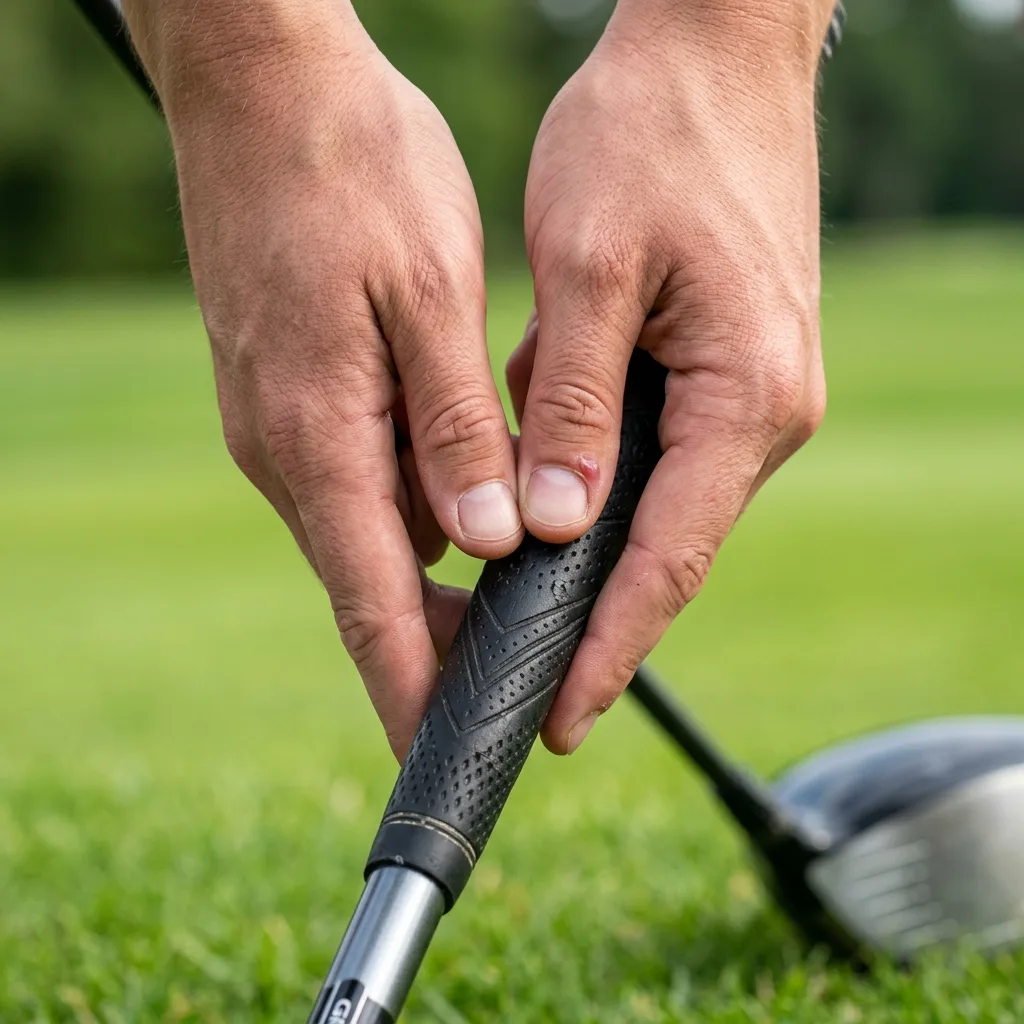
In the world of golf, there are basically three main, historically proven ways to bring both hands on the grip together to work as one compact unit.
Choosing the right style largely depends on the anatomical size of your hands, the length of your fingers, your physical strength, and last but not least, personal preference and comfort. Let’s look at them in more detail.
The first and historically most popular isoverlapping grip, very often also referred to as the famousVardon Overlap, named after the legendary champion Harry Vardon, who popularized it at the turn of the 19th and 20th centuries.
With this elegant style, the little finger of your lower hand (for right-handed people) rests exactly in the hollow, or gap, between the index and middle fingers of your upper hand. It is by far the most used style on professional tours around the world.
Works great especially for players with average or larger hands and long fingers. It prevents the dominant right hand from taking too much control of the swing, which is key to maintaining a neutral clubhead position.
The second, very specific type is theinterlocking grip(or Interlocking Grip). Here, the little finger of your lower hand will directly and tightly intertwine with the index finger of your upper hand.
We’ve found that players with smaller hands, shorter fingers, or those who feel like their hands are coming apart during the swing tend to prefer and love this style.
Because it physically locks the hands together, it prevents them from sliding even in rainy weather or when sweating excessively. It’s no coincidence that two of the greatest legends in golf history, Tiger Woods and Jack Nicklaus, used this exact grip style throughout their careers.
The third and no less interesting option is the so-calledten-finger grip, which is often called the baseball grip among players.
As the name suggests, the Ten-Finger Grip is characterized by all ten fingers lying directly next to each other on the club handle without overlapping or intertwining in any way.
For adult, physically strong men, this style is usually not highly recommended as it often results in overactive right hand and inconsistent shots.
However, for beginning juniors, women, players with arthritis or golfers with less physical strength, it can be an absolutely ideal choice at first, as it allows more pressure to be exerted and makes it easier to feel the swing with a heavy driver.
Over time, however, most trainers recommend transitioning to one of the two overlapping grips mentioned above.
Step by Step: How to Position Fingers and Palms on the Grip
Now let’s show you how to grip the driver in a practical and very detailed way. Follow this manual carefully, step by step, to nip any bad habits in the bud.
Start by standing up straight and grasping the club in your right hand by the steel or carbon shaft (just below the rubber grip). Place the club head on the ground in front of you so that the hitting surface is perfectly perpendicular to your imaginary target.
This first step is critical because if you start with a crooked club, your grip will automatically compensate for this error.
First, raise the club slightly in the air in front of you and place yourlead hand(left hand for righties) on the grip.
The club must pass diagonally across yourfingers(fingers) – from the base of the little finger to the middle joint of the index finger, not the middle of the palm.
Close your fingers and then flip your entire palm over the handle. Make sure your left thumb is not directly on the top edge of the grip, but slightly to the right of the imaginary center of the grip.
If you now look down at your closed left hand from your natural playing position, you should see two to two and a half clearly and without difficultyknuckles (klouby).
If you don’t see these Knuckles, it means your grip is too weak and you need to turn your hand more to the right, away from the target.
Next, with your left hand already firmly established, add yourtrail hand(right hand). She should approach the club from the side and below rather than from above.
The right hand should grip the stick even more in the fingers than the left. The life line of your right hand (the soft part of the palm below the thumb) should comfortably and precisely overlap the thumb of the left hand.
This ensures that both hands fit together like pieces of a puzzle and work as one absolutely coordinated unit.
You’ve created a solid block that is absolutely critical for long, straight and consistent driver shots.
Try waggle your wrist a few times to feel the weight of the club head and confirm that your grip is not cramping.
Grip Strength and Pressure: How to Hold the Pole Tightly?
The fundamental question of how hard to grip a rubber grip worries almost every novice and slightly advanced player on the golf course.
Our all-natural human instinct, especially when holding a long and heavy-feeling weapon like a driver, is to grip the handle as hard as possible.
After all, we want to give the maximum physical impact to the shot and not let go of the stick. However, in the biomechanics of the golf swing, the opposite is true.
An excessively large and spasmodicGrip Pressure(grip pressure) automatically locks your wrists, strengthens your forearms, and tightens your shoulder muscles. Stiff muscles simply cannot move fast enough.
To achieve the absolute maximum possible clubhead speed (clubhead speed) just before hitting the ball, you must keep your hands and arms relatively relaxed.
Think of a classic scale of one to ten, where one means the stick will fall out of your hand and ten is the maximum possible death grip.
During your basic stance, you should hold the club with about a force of four.
Well-known golf legend Sam Snead always said that you should hold the club in your hands like you would hold a small live bird in your hand – you don’t want to crush it roughly, but you also don’t want to let it fly away.
During the swing, the relaxed wrist acts as a dynamic whip that accumulates energy at the top of the swing and gives the ball a huge explosive speed at the moment of impact.
If you are eager to find the right and most technologically advanceddriver for distancefor your game, there is one thing you need to be fully aware of.
Even the absolute most expensive custom titanium club on the market will fail completely if you grip it spasmodically throughout the swing and don’t let it do its job.
During the actual impact on the ball, your grip naturally and subconsciously tightens due to physical forces, so you definitely don’t have to worry about the club unexpectedly flying forward from your hands during the actual strike.
The most common mistakes made by beginners: how to hold a golf club driver for beginners a slice
By far the biggest, most frustrating, and most widespread problem that plagues the vast majority of newbies with a driver in their hand is the dreadedslice.
This annoying phenomenon where your ball starts flying beautifully and hopefully straight, but after a few tens of meters in the air it suddenly starts to spin and unstoppable turning to the right (for right-handed players), very often has a direct and indisputable connection with how the technique is theoretically and practically appliedhow to hold a golf club driver for beginners.
When you apply what’s called a weak grip—meaning your left lead hand is turned too far to the left (toward the target) and your thumb points straight down the centerline of the grip while your right hand rests too high on the grip—you’re setting yourself up for a huge problem.
The human body always subconsciously tries to return the arms to their neutral, resting position during a dynamic swing. If you start with a weak grip, your hands will naturally rotate back as you move down to the ball.
This will inevitably cause the face of your club to open up at the critical moment of impact (the clubface will point to the right of the target).
The result is an extreme lateral rotation (spin) of the ball to the side, which uncompromisingly sends your long shot deep into the trees outside the playing fairway like a sharp boomerang.
We have found that the quickest fix to this chronic problem is a relatively simple grip strengthening.
It is enough to turn both of your hands on the grip slightly more to the right, i.e. away from the target, which will make it much easier to close the club head in time and correctly when hitting the ball.
This stronger grip works as a perfect prevention of open club head manifestations and helps you reduce unwanted side spin.
If you’re struggling with a difficult putt, this should be the very first thing you check and correct with your coach or at the driving range yourself.
Modern Biomechanics: Why a Stronger Grip Helps with Driver
In the last few years, the overall approach to teaching golf technique has changed quite significantly. This is mainly due to a deeper understanding of advanced sports biomechanics and the availability of accurate analytical data from sophisticated radars such as Trackman or FlightScope.
In past decades, a strictly neutral grip was widely recommended to all beginners in traditional golf schools. However, today’s hard empirical data from millions of analyzed swings clearly shows that modern high-volume drivers require a slightly different treatment.
460cc drivers (which is the maximum allowed today) are fantastic for stability and off-center forgiveness (they have a high MOI), but are also relatively heavy and bulky in terms of spin.
Therefore, they require a specific approach to timing the rotation of the forearm during the swing (technically called supination and pronation).
A stronger grip, when both hands are already slightly turned to the right at the base (for right-handed people), biomechanically makes the necessary rotation of the arms in the impact zone much easier.
This way, your body doesn’t have to convulsively try to make an extreme and unnatural effort in the microseconds before impact to align the big, heavy club head perpendicular to the ball in time.
This modern knowledge in the field of biomechanics is literally a groundbreaking discovery for beginners. It allows them to swing much more naturally, loosely, and even aggressively, without fear of a slightly delayed hand rotation sending the ball across the court and into the woods.
For many years, we were warned by old-school coaches that a strong grip inevitably leads to a nasty hook (a low flight of the ball that turns sharply to the left – the so-called hook).
However, the truth is that with a large modern driver and the average beginner’s swing (which is often sub-optimal from outside to inside), a stronger grip works as an absolutely excellent compensation for deficiencies in hip and trunk rotation.
In short and well, this biomechanical grip trick will forgive you a huge number of other, much more difficult to correct movement errors.
Driver Grip Conclusion and Next Steps on the Driving Range
Correct grip on the modern driver is definitely not some unattainable black magic reserved only for professional players on the PGA Tour.
It is purely and simply about a mechanical understanding of how your own hands spatially control the entire club and how optimally they transfer the accumulated kinetic energy from your body directly to the flying ball.
However, don’t expect miracles immediately without effort. Devote sufficient time to honest and targeted training. On each of your next visits to the practice driving range, check the position of your palms carefully, even meticulously, before each shot.
Focus on finger placement, checking the exact number of visible knuckles on the left hand as well as the overall correct direction of the V-shape of both of your hands towards the right collarbone.
Remember that any new, slightly modified grip will naturally feel very uncomfortable, foreign and maybe a little clumsy in the first dozen attempts. You will feel as if you are holding a stick for the first time in your life.
It is a completely normal and natural process of rewriting your muscle memory in the brain.
However, if you persevere and don’t immediately revert to your original bad grip after the first shot (just because it feels “more comfortable”), I can guarantee that your tee shots will soon become radically longer and, above all, even.
Check out our handpicked FAQs below to definitively clear up any other minor conundrums before you hit the road for your next big workout.
Frequently Asked Questions
How tight should I hold the driver when hitting the ball?
You should hold the driver firmly enough so that it doesn’t slip during a fast swing, but loose enough at the same time. On a scale of 1 to 10, your grip pressure should be around a 4. A looser grip has been proven to help free up the wrist and dramatically increase clubhead velocity.
Is interlocking or overlapping grip better for beginners?
For complete beginners with average-sized or larger hands, the overlapping grip is generally preferable because it better supports a relaxed wrist and natural swing. Interlocking grip, on the other hand, is often recommended and used for players with smaller hands or shorter fingers, as it ensures much better overall stability during a dynamic driver swing.
Why does my driver keep getting sliced?
A strong slice with a driver is in most cases caused by a so-called weak grip for beginners. This leaves the striking surface open to the right at the moment of impact with the ball. The quickest solution is to slightly strengthen your grip – by turning both hands on the grip slightly to the right so that when you look down you can see clearly and distinctly two to three knuckles of your left hand.
Do I have to hold the driver differently than my irons?
The basic principles of the combined two-hand grip are very similar, but with the driver you play a large ball from a high club and try to hit it while moving the club slightly upwards. A slight strengthening of the grip helps beginners to close the wide hitting face of the long club much better and in time, which in turn maximizes the launch distance and effectively reduces unwanted spin to the side.
What is a baseball grip and is it suitable for playing with a driver?
In the baseball (ten-finger) grip, all ten fingers touch the handle directly without any overlap or interweaving. It is a style very suitable primarily for juniors, women, seniors or players with overall less physical strength, giving them a feeling of firmer control. However, most professionals recommend that after mastering the basics, you can smoothly switch to classic overlapping or interlocking for much better synchronization of the work of both hands during a very fast swing with the driver.
Get our latest guides, news, and insights highlighted in your Google Search & AI Overviews.