
✨ This article was AI edited. Editorial responsibility: GolfGearDirect.blog.
Learning how to drive a golf cart safely on a busy course requires high awareness. Many beginners feel extreme nervousness behind the steering wheel. The fear of causing an accident makes that initial ride very intimidating.
We tested various approaches to teaching new drivers. We found that learning the basic controls is only half the battle. You must also understand the unspoken rules of the road.
Recently, there has been a significant rise in accidents in neighborhood communities. These often involve first-time drivers who underestimate the vehicle’s mechanics. However, one specific mistake accounts for most of these incidents.
People completely ignore this crucial detail until it is too late. This mistake dictates whether you enjoy a smooth ride or crash. We reveal this exact detail in the very next section.
Table of Contents
- How to drive a golf cart: The short answer
- Understanding the basic controls: Ignition, accelerator, and brake pedal
- Electric golf cart vs gas-powered cart: What’s the difference?
- Step-by-step: How to drive a golf cart safely on the course
- Navigating neighborhood communities: Are you street-legal?
- Golf cart safety and rules you must follow
- Final tips before you hit the pedal
- Frequently Asked Questions
How to drive a golf cart: The short answer

Learning how to drive a golf cart starts with the core components. You must understand the dashboard before turning the key. Step into the seat and survey the entire floorboard area.
You will find the ignition switch on the right side. Below your feet, you will notice two main pedals. The wider left pedal is the brake pedal.
The narrower right pedal is the accelerator pedal. Before touching the ignition, ensure the vehicle remains stationary. You must confirm that the parking brake is fully engaged.
The parking brake is built into the brake pedal. You release it by pressing the lower section until it clicks. Next, locate the forward/reverse switch near your leg.
When you are ready to move, flip the switch forward. Turn the key in the ignition to power the entire system. Grip the steering wheel firmly with both hands.
Slowly and progressively press the accelerator pedal. A golf cart responds almost instantly to the accelerator pedal. A heavy foot can cause the vehicle to lurch violently.
Keep your driving movements smooth and deliberate at all times. You might spot players swinging golf drivers on the fairway. Always maintain a safe distance from other golfers.
To stop, lift your foot off the accelerator pedal. Apply steady pressure to the brake pedal. This ensures a smooth and safe halt.
Understanding the basic controls: Ignition, accelerator, and brake pedal
Once you know the quick steps, deeply understand the mechanical controls. The ignition system completes the circuit to the battery. Turning the key arms the vehicle for immediate movement.
You might not hear a traditional engine roar. Modern electric models operate in complete silence. However, the vehicle remains fully active and ready to drive.
The gear selector gives you control over the cart. It is a simple directional toggle switch. You only have three distinct positions: forward, neutral, and reverse.
Many newer models emit a loud continuous beeping sound. This happens when the gear selector is placed in reverse. This auditory warning alerts bystanders to your reversing vehicle.
Rear visibility from the driver seat is severely restricted. You must rely on mirrors and careful observation. Always turn your head to check for hidden obstacles.
Your mastery of the accelerator determines your ride quality. The cart lacks the heavy suspension of a standard automobile. Every foot movement translates directly to the chassis.
Pressing the accelerator too quickly causes traction loss. This happens frequently on wet grass or loose gravel. You must avoid sudden acceleration spikes.
Slamming the brake pedal can lock the wheels completely. This sends the cart into an uncontrolled hazardous slide. Apply and release pressure gradually to maintain control.
Electric golf cart vs gas-powered cart: What’s the difference?
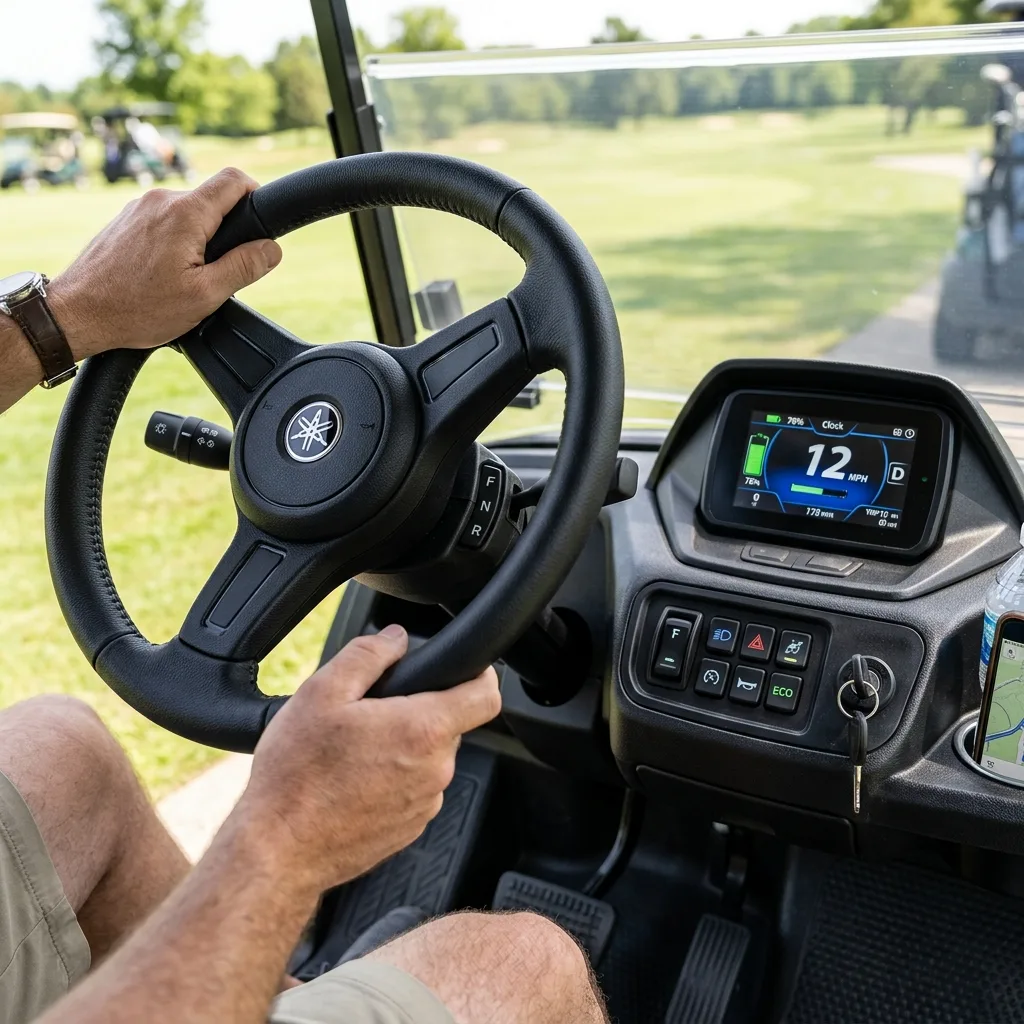
When you visit a modern golf facility, you face a choice. You must choose between an electric golf cart and a gas-powered cart. Understanding the fundamental differences is vital for beginners.
Electric Golf Carts: Their power delivery and daily maintenance profiles vary significantly. An electric golf cart runs entirely on deep-cycle batteries. These batteries sit securely under the main seating bench.
These vehicles provide whisper-quiet operation and zero emissions. They are the preferred choice for early morning golf rounds. Noise discipline is essential on luxury golf courses.
When you press the pedal in an electric cart, torque is instant. The electric cart accelerates surprisingly fast from a dead stop. This instant power requires a very gentle touch.
A sudden mash of the pedal catches passengers off guard. The overall driving range is limited by battery capacity. You must carefully monitor the charge indicator during trips.
Gas-Powered Carts: In contrast, a gas-powered cart operates using an internal combustion engine. It uses a single-cylinder motor fueled by standard gasoline. When you turn the ignition, you hear distinct engine noise.
You feel a slight vibration flowing through the chassis. The power delivery is gradual compared to electric models. This provides a steady and predictable build-up of speed.
The gas cart excels in hilly terrain and long distances. They do not face strict battery life constraints. However, they require regular mechanical maintenance and oil changes.
Step-by-step: How to drive a golf cart safely on the course
Learning how to drive a golf cart safely involves course etiquette. Turf protection is just as important as physical driving skills. Every golf course enforces a strict set of rules.
These rules protect players and the delicate expensive grass. First, always strictly adhere to the ninety-degree rule. This rule mandates keeping the cart on the paved path.
You stay on the path until adjacent to your golf ball. Then, you make a sharp turn onto the grass. Drive straight to your ball and play your shot.
Immediately drive straight back to the designated paved path. This minimizes tire traffic on the fairway turf. It prevents unsightly rutting and severe soil compaction.
Second, pay close attention to designated restricted zones. Never drive within thirty yards of a putting green. You must avoid tee boxes, sand bunkers, and water hazards.
The soil in these areas is soft and easily damaged. When parking on an incline, engage the parking brake fully. Do this before stepping out of the vehicle.
You might watch a partner test a driver for distance. Park the cart completely off the grass. Remain quietly seated until they complete their full swing.
Respecting operational boundaries keeps the course in pristine condition. It ensures you avoid angry reprimands from course marshals. Always follow the signs posted along the path.
Golf carts have become incredibly popular outside the fairways. They serve as primary transportation in gated neighborhood communities. Transitioning to public roadways introduces new roadway safety challenges.
Drivers mistakenly assume standard rules of the road do not apply. This risky misconception fuels the recent spike in neighborhood accidents. You must treat the vehicle like a real car.
Before driving on public streets, verify your compliance status. You must confirm whether the vehicle is officially street-legal. A street-legal cart requires specific mandatory safety modifications.
These modified vehicles are called Low-Speed Vehicles or LSVs. Mandatory upgrades include approved windshields and functioning headlights. You also need taillights, turn signals, and exterior mirrors.
Furthermore, driving an LSV requires a valid state driver license. You must have vehicle registration and active protection plans. Do not drive on roads without these mandatory requirements.
When operating within communities, strictly obey all posted speed limits. Speed limits are usually capped at twenty miles per hour. A golf cart offers zero structural protection in collisions.
Always drive defensively and signal your intentions early. Yield the right-of-way to pedestrians, cyclists, and larger cars. Never assume other drivers can see your small vehicle.
Treat the cart with extreme respect and deep caution. Apply the same care used when driving your family sedan. This mindset prevents tragic accidents in your local neighborhood.
Golf cart safety and rules you must follow
The open-air design provides a thrilling sense of total freedom. However, it removes physical barriers that protect occupants. Adhering to strict safety rules is absolutely non-negotiable today.
The foundation of this safety protocol begins with passenger management. Every vehicle features strict passenger limits based on seats. Never attempt to squeeze an extra person onto the bench.
Do not allow anyone to stand on the rear bumper. Overloading the cart dramatically shifts its center of gravity. This significantly increases the risk of a rollover accident.
You must also respect the manufacturer specified weight limits. Excessive weight severely compromises the vehicle overall braking distance. It damages the suspension and drains the battery rapidly.
Always instruct your passengers to wear their seat belts. Standard course carts often omit belts for quick player exits. Modified community carts feature them as a mandatory safety upgrade.
As the driver, you bear ultimate responsibility for everyone onboard. Insist that passengers keep arms inside the cabin. Limbs must remain inside the vehicle while moving.
A highly hazardous practice involves dangling feet outside the cart. If the driver unexpectedly swerves, that limb gets crushed. You must establish these ground rules immediately.
Do this before you ever turn the ignition key. Clear communication prevents severe injuries during casual rides. Safety always comes first on every single trip.
Final tips before you hit the pedal
Taking control of a golf cart should be truly enjoyable. It should never be a source of intense stress. Mastering fundamental controls positions you to drive confidently anywhere.
Practice and patience remain your very best educational tools. Find an empty parking lot or a quiet grass area. Do this before venturing into heavily populated community zones.
Spend fifteen minutes simply practicing your starts and stops. Get a distinct feel for the required accelerator pressure. Understand how much distance the brakes need to halt.
Practice shifting the forward and reverse switch seamlessly. Familiarize yourself with the exact vehicle turning radius. This ensures tight corners never catch you off guard.
Always keep situational awareness as your absolute top priority. Scan the horizon to prevent the majority of potential accidents. Keep your eyes focused firmly on the path ahead.
Treat every ride with deep respect for machine capabilities. Maintain a steady speed and obey all posted signage. Prioritize the physical safety of your passengers above all else.
You will quickly transition from an unsure, nervous beginner. You will become a seasoned, highly confident community driver. Enjoy your safe journey on the beautiful golf course.
Frequently Asked Questions
Do I need a license to drive a golf cart?
Generally, you do not need a license to drive a golf cart on private property like a golf course. However, if you are driving on public roads, you must follow local street-legal regulations, which often require a valid driver’s license.
Get our latest guides, news, and insights highlighted in your Google Search & AI Overviews.