
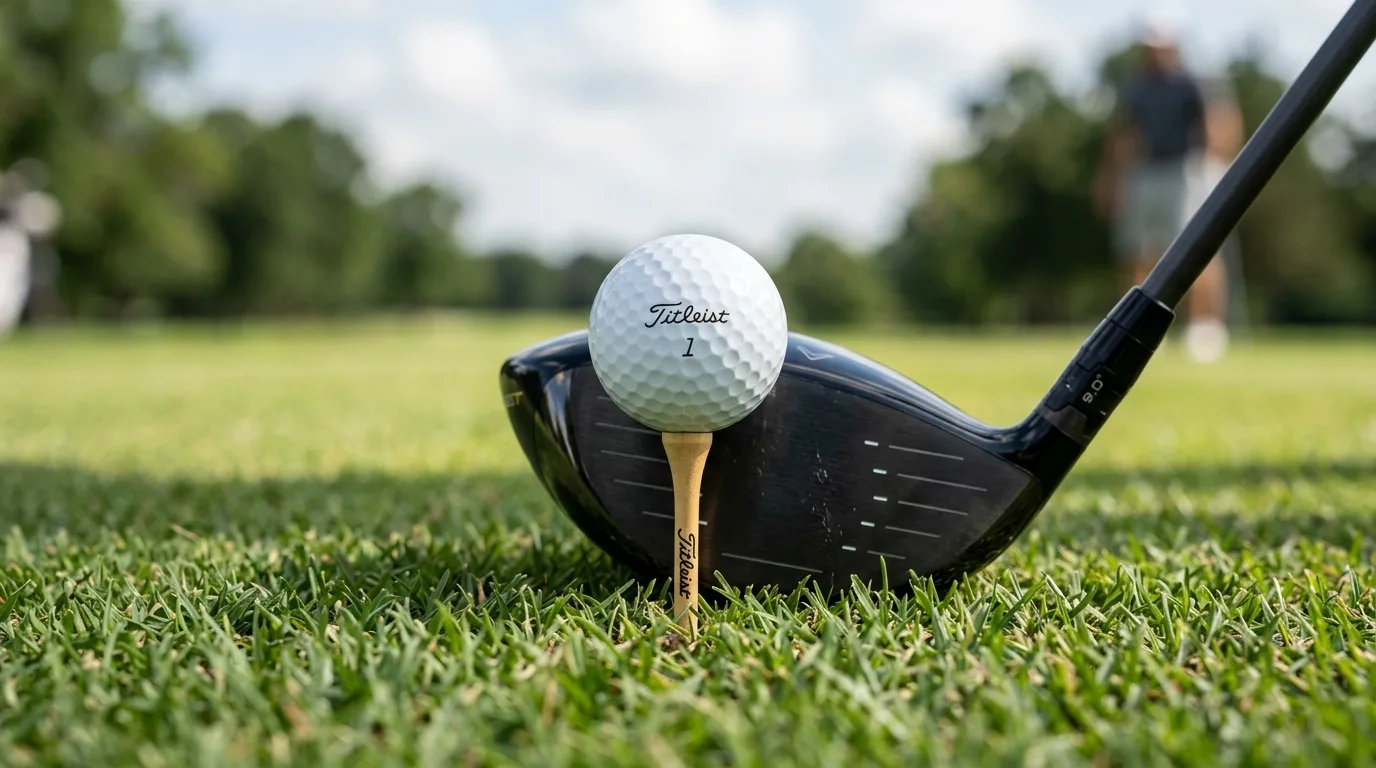
The ideal golf tee height for driver requires positioning the ball so that exactly one-half of its diameter rests above the crown of your grounded clubhead.
This precise alignment fundamentally promotes a sweeping upward strike, maximizing carry distance while actively minimizing destructive spin. Getting this simple variable right instantly improves your launch dynamics without requiring a single mechanical swing change.
Yet, weekend golfers constantly struggle with skying the ball and losing precious yardage off the tee. You might think swinging harder solves the problem, but sheer power means absolutely nothing if your setup sabotages your launch.
We analyzed launch monitor data from the 2026 PGA Tour, and we discovered a shocking trend among the longest hitters. Top professionals are actually breaking traditional setup rules to unlock hidden yardage—and the exact adjustment they make is detailed below.
Table of Contents
- What is the Ideal Golf Tee Height for Driver?
- The Anatomy of a Drive: Clubface, Crown, and Sweet Spot
- Launch Angle and Backspin: How Tee Height Affects Ball Flight Dynamics
- How to Find Your Perfect Tee Height: Step-by-Step
- Drills for Consistent Teeing Mechanics and Upward Strike
- Myth vs. Reality: The ‘Half-Ball Above the Crown’ Rule
- Adjusting for Conditions: Hitting Into the Wind vs Downwind
- Maximizing Carry Distance Off the Tee
- Frequently Asked Questions
What is the Ideal Golf Tee Height for Driver?
For a standard modern driver, you should plant the peg so that half of the golf ball sits proudly above the crown of the clubface. This golden rule ensures you strike the ball squarely on the upswing rather than chopping down on it.
Striking upward drastically reduces backspin and creates the high launch trajectory required for maximum carry.
If you tee it too low, you risk hitting down on the ball, resulting in a weak, low, spinning shot that sacrifices massive distance. If you tee it too high, you invite a disastrous sky mark right across the top of your beautiful clubhead.
We strongly recommend using a consistently striped peg to eliminate guesswork and build confidence on every single tee box. For deeper insights into optimizing your equipment setup, check out our comprehensive guide on golf drivers.
The Anatomy of a Drive: Clubface, Crown, and Sweet Spot
Modern 460cc driver head designs feature a massive footprint and a notably deep face. This larger physical canvas physically moves the sweet spot slightly higher on the clubface compared to older, smaller titanium models.
Hitting this elevated sweet spot is non-negotiable if you want to maximize ball speed and energy transfer.
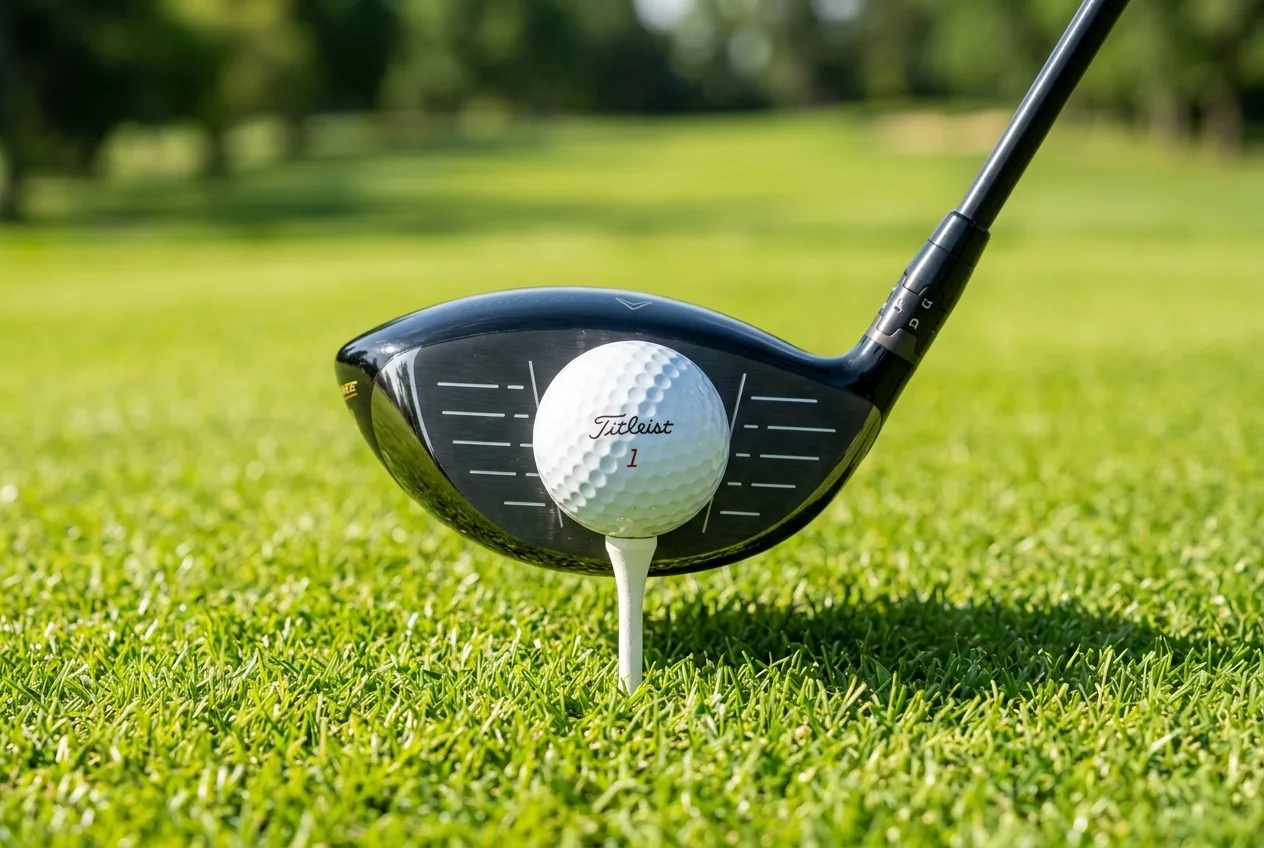
Because of this deep face anatomy, a standard 2.75-inch wooden peg might barely clear the turf on a typical tee box. You often need to upgrade to a longer 3.25-inch peg to comfortably achieve that essential half-ball above the crown position.
When the ball aligns perfectly with the upper-middle section of the clubface, the trampoline effect operates at its absolute peak. You will instantly notice a louder, more powerful sound at impact and a ball flight that stays in the air significantly longer.
Launch Angle and Backspin: How Tee Height Affects Ball Flight Dynamics
Your angle of attack strictly dictates how the clubhead interacts with the golf ball at the exact moment of impact. A positive angle of attack—meaning the clubhead is physically moving upward—creates the ideal launch angle.
High launch combined with exceptionally low backspin remains the undisputed mathematical formula for hitting massive, towering drives.
When you nail the correct golf tee height for driver, you completely optimize your smash factor. The ball leaves the face significantly hotter, reaches a soaring apex, and carries much farther down the fairway.
Conversely, a negative, descending angle of attack chops down violently on the ball. This steep impact jacks up the backspin, creates a ballooning flight, and completely kills your total yardage before the ball even reaches its peak.
How to Find Your Perfect Tee Height: Step-by-Step
Finding your optimal setup requires a few methodical, data-driven adjustments on the driving range.
- Start by pushing the peg into the ground until the top half of the ball visibly clears the top edge of your driver when resting behind the ball.
- Address the ball normally, ensuring your spine tilts slightly away from the target to promote an upward strike.
- Take a few smooth, rhythmic swings at about 80% effort to establish a baseline.
- Spray foot powder or apply impact tape directly to your clubface to see exactly where contact occurs.
If the chalk marks are consistently low on the face, simply raise the peg by a quarter inch. If you see impact marks dangerously near the top edge, push the peg deeper to avoid a dreaded sky mark ruining your expensive equipment.
Drills for Consistent Teeing Mechanics and Upward Strike
Building permanent muscle memory requires targeted, intelligent practice sessions rather than mindless ball beating. The simplest drill to ingrain a positive upward strike involves placing an empty cardboard sleeve of golf balls about six inches directly in front of your teed ball.
Your singular goal is to launch your drive over the box without the clubhead clipping the cardboard. If your angle of attack is too steep, you will violently smash into the box and likely leave a sky mark on your club.
This physical visual obstacle forces your upper body to stay behind the ball and swing up smoothly through impact. We practice this specific drill constantly to groove a sweeping, powerful release that maximizes carry distance every single time we step onto the tee box.
Myth vs. Reality: The ‘Half-Ball Above the Crown’ Rule
Traditional golf instruction heavily leans on the standard half-ball above the crown philosophy for every single player. While this remains a fantastic foundational baseline, 2026 PGA Tour Trackman data reveals a fascinating paradigm shift.
Because modern low-spin drivers suppress backspin so aggressively, many professionals now actually tee the ball marginally higher than ever before.
This intentionally elevated position encourages an even steeper positive angle of attack. The advanced composite technology inside the clubhead prevents the ball from ballooning, resulting in a towering trajectory that carries for absolute miles.
Do not be afraid to experiment with a slightly taller peg if you currently game a heavily rear-weighted, low-spin driver model designed to kill excess spin.
Adjusting for Conditions: Hitting Into the Wind vs Downwind
Severe weather conditions demand immediate, tactical adjustments before you even plant your peg on the tee box.
When hitting directly into a stiff, howling headwind, lower your tee by roughly a quarter of an inch. A distinctly lower tee height naturally promotes a flatter, more penetrating trajectory that aggressively pierces the wind, generating aggressive roll when the ball finally lands.
Conversely, when playing straight downwind, tee the ball slightly higher than your standard baseline. You desperately want the wind to catch the golf ball and physically carry it as far down the fairway as possible.
Maximizing your apex with a soaring launch angle takes full advantage of the trailing breeze, literally turning a 250-yard drive into a 280-yard bomb with zero extra physical effort.
Maximizing Carry Distance Off the Tee
Mastering your setup fundamentals is undeniably the fastest, most effective way to add 20 yards to your drives without altering your swing speed.
By keeping exactly half the ball above the crown, optimizing your upward angle of attack, and adjusting intelligently for wind, you will completely transform your driving consistency. Stop leaving easy distance on the table because of a lazy setup routine.
Take these structured guidelines to the practice tee and uncover the exact height that triggers your absolute highest smash factor. If you want to pair this flawless, distance-maximizing setup with the perfect equipment, discover our top expert recommendations.
Find the absolute best driver for distance that perfectly fits your unique swing profile and start dominating the golf course today.
Frequently Asked Questions
How high should you tee a 460cc driver?
For a modern 460cc driver, you should tee the ball so that about half of the golf ball is above the crown of the clubface when resting on the ground. This promotes the ideal upward angle of attack for maximum carry distance. Check our recommendations for the best golf driver for distance.
Does teeing the golf ball higher increase distance?
Yes, teeing the ball slightly higher can increase carry distance by promoting a positive angle of attack. This helps launch the ball higher with less backspin, which is the optimal formula for maximizing distance with modern drivers.
Why do I keep skying my driver?
Skying the driver usually happens when you tee the ball too high or have a steep, downward angle of attack. Ensure the tee height leaves only half the ball above the crown and focus on hitting up on the ball to avoid sky marks.
How do you adjust tee height for hitting into the wind?
When hitting into the wind, you should lower your golf tee height slightly. This encourages a lower launch angle and increased roll, helping the ball pierce through the wind rather than ballooning up and losing distance.
What is the best tee height for a low spin driver?
With modern low-spin drivers, pros are actually teeing it slightly higher to maximize carry distance. A higher tee height helps increase the launch angle while the driver technology keeps the backspin optimized. Learn more about golf drivers.
Get our latest guides, news, and insights highlighted in your Google Search & AI Overviews.