
✨ This article was AI edited. Editorial responsibility: GolfGearDirect.blog.
When searching for the perfect golf tee for drive range practice, you need a setup that mimics real grass perfectly. You grab your biggest club, but you are immediately forced to use a thick, yellow rubber tube that is either way too high or ridiculously short.
Table of Contents
- Why You Need a Specific golf tee for drive range
- The Problem with Standard Rubber Tubes
- Top Innovations in Range Practice Gear
- How to Set Your Driver Height Properly
- Finding the Best golf tee for drive range Mats
- The Double-Tee Trick: A Free Alternative
- Simulator Setups vs. Outdoor Mats
- Building a Winter Practice Routine
- Analyzing Ball Flight on Synthetic Turf
- Durability Breakdown: Plastic vs. Rubber vs. Wood
- Practicing Shot Shaping Off the Mat
- Maintaining Posture and Avoiding Compensations
- The Psychological Impact of Quality Practice
- Drills to Maximize Your Range Sessions
- Final Recommendations for Your Range Bag
- Frequently Asked Questions
Why You Need a Specific golf tee for drive range
Practicing on synthetic turf is completely different from playing on real grass.
When you use traditional rubber tees at a public facility, you cannot adjust the driver height to match your natural, ingrained swing. This forces you to make subconscious postural compensations that destroy your consistency over time.
If you want to maximize your driver for distance, you need a setup that replicates actual course conditions flawlessly.
Finding the right golf tee for drive range practice is absolutely crucial for serious game improvement.
Whether you are at a local facility or hitting into a high-end golf simulator in your garage, the physical resistance of the tee changes your impact dynamics entirely. A proper range tee allows the clubhead to glide smoothly through the hitting zone.
This gives you realistic feedback instead of a heavy, artificial thud that jars your wrists and lies about your swing path. Many amateurs ignore this detail and wonder why their range sessions never translate to lower scores on the scorecard.
The truth is, your equipment dictates your practice quality. When you invest in a proper setup, you instantly elevate the value of every single practice swing you make.

The Problem with Standard Rubber Tubes
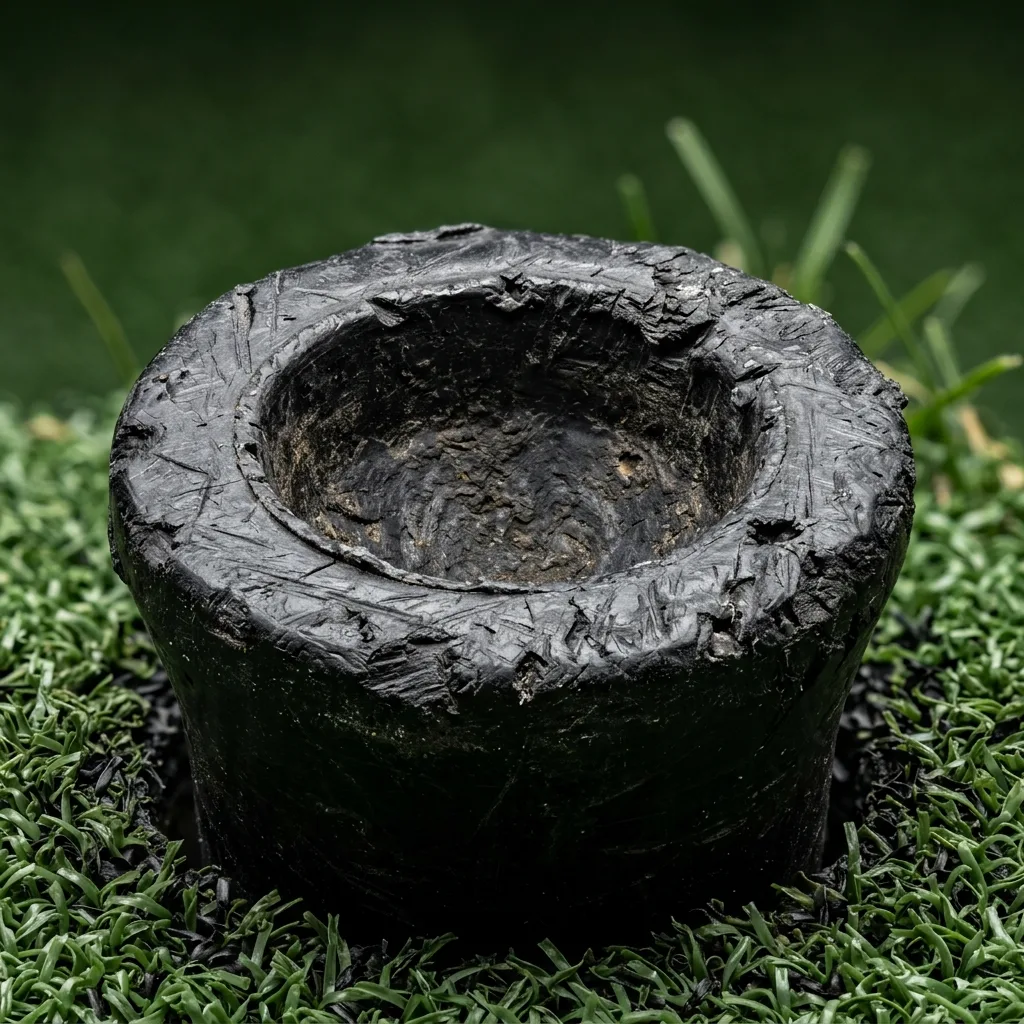
Most public ranges provide fixed-height rubber cylinders that are designed for longevity, not for player performance. These are incredibly durable for the facility but terrible for your game development.
They offer far too much resistance against the clubface during the critical moment of impact. This excess resistance can slow down your clubhead speed and cause false spin readings on advanced launch monitors.
You might think you hit a massive slice, but the rubber tube simply grabbed the sole of your driver.
Furthermore, you cannot easily switch between hitting a driver and hitting your irons. If you want to practice stinging a fairway wood, the standard tube is obnoxiously tall.
If you use a traditional wooden tee or a standard plastic tee, you have nowhere to stick it on a concrete-backed artificial mat. You need an adjustable tee system to practice your entire bag properly.
Without an adjustable tee, you are essentially practicing with a handicap. You are forcing your body to adapt to the mat, rather than adapting the mat to your natural golf swing.
This leads to ingrained bad habits that will haunt you during your weekend rounds.
Top Innovations in Range Practice Gear
The golf equipment market has responded with several brilliant solutions designed specifically for synthetic mats.
The Tee Claw is currently the most popular system among top-tier instructors and touring professionals. It uses a clever base unit that physically grips into the artificial turf fibers, allowing you to insert any standard peg into it securely.
This completely eliminates the need to awkwardly lift heavy, dirty mats to push a rubber tube through from the bottom.
Another excellent option is the highly regarded BirTees system. These uniquely shaped tees sit directly on top of the turf surface and come in a convenient multi-pack of various heights.
They are exceptionally durable and fly forward safely on impact without breaking or shattering. Finally, Tomahawk tees offer a highly unique flexible design that instantly collapses upon impact, reducing clubface resistance to absolute zero.
Each of these innovations provides a massive upgrade over the standard equipment found at your local driving range.
Testing a few different styles will help you discover which specific design matches your individual angle of attack and clubhead speed.
How to Set Your Driver Height Properly
Consistency off the tee box starts with a highly repeatable driver height. On the actual golf course, you probably tee the ball so its equator perfectly aligns with the upper crown of your driver.
You must replicate this exact height on the range to ensure accurate practice. If your range tee is too high, you will inevitably hit high on the face and painfully sky the ball.
If it sits too low, you will thin the ball and lose massive amounts of carry distance.
When switching to fairway woods or utility clubs, the ball needs to sit barely above the synthetic turf. A good training aid will offer multiple height options or continuously adjustable bases to accommodate these different clubs.
Always measure your preferred height against your clubhead before you start swinging wildly. Taking five seconds to check this alignment will save you hours of frustrating swing flaws.
Every professional golfer meticulously checks their tee height before executing a drive. You should adopt this exact same level of precision during your weekly practice sessions.
Finding the Best golf tee for drive range Mats
Choosing the right equipment heavily depends on your typical practice environment and the specific mats you encounter. If you visit ranges with extremely tight, worn-out mats, surface-resting tees work best.
They do not require deep turf fibers to anchor themselves securely. If you have a premium, thick-pile mat at home, an anchoring system provides significantly more stability against aggressive swings.
Your personal choice of golf drivers also dictates your optimal tee choice. Deep-faced modern drivers require much taller tees than older, more compact models.
Therefore, the best golf tee for drive range use must offer extreme height adjustability to match modern clubhead geometries. Never settle for a one-size-fits-all solution when your golf swing is entirely unique to you.
Investing in a customized setup ensures that your practice sessions are tailored to your specific biomechanics and equipment choices. This customized approach is the secret to breaking through performance plateaus.
The Double-Tee Trick: A Free Alternative
If you do not want to buy specialized gear right away, you can use a clever hack favored by many professional players. This technique is universally known as the double-tee trick.
You take the standard rubber cylinder provided by the facility and a regular wooden peg straight from your golf bag. Drop the wooden peg inside the hollow center of the rubber cylinder so it pokes out the top.
This brilliantly simple setup allows you to customize the height infinitely. You simply push the wooden peg down firmly or pull it up slightly to match your exact visual preference.
When you strike the ball, you hit the wooden peg, providing the exact same feel and crisp auditory feedback as a real grass tee box.
The only minor downside is that you might break a few wooden pegs during your session, so bring plenty of spares. This method is highly effective, costs absolutely nothing, and instantly upgrades your practice quality. It proves that you do not always need expensive gadgets to improve your golf game.
Simulator Setups vs. Outdoor Mats
Indoor golf simulators have completely changed how we practice during the long, cold off-season. However, simulator mats are often much thicker and significantly softer than outdoor commercial mats.
This means surface-resting tees might wobble unpredictably or sink deeply into the plush turf. You need a highly stable base to ensure accurate launch monitor readings. Launch monitors track micro-movements, so a wobbly ball can ruin your data.
Outdoor mats, on the other hand, are usually glued directly to rigid concrete slabs. They are incredibly stiff and brutally unforgiving on your joints.
Hitting down into these hard mats can actually cause severe wrist injuries over time. Using a dedicated, shock-absorbing tee system protects your joints from the harsh impact. It allows the clubhead to pass through the impact zone smoothly without snagging aggressively on rigid rubber.
Building a Winter Practice Routine
As the weather turns cold and courses close, your practice routine must adapt accordingly. Hitting balls mindlessly off a mat for an hour will not lower your handicap next spring.
You need intentional, highly focused practice sessions. Start by carefully calibrating your impact position using standard foot powder spray on your clubface. This reveals exactly where you are making contact with the ball.
Next, intentionally alternate between different tee heights to test your physical adaptability. Hit five balls with your standard height, then five with a slightly lower setup to simulate a tight lie.
This builds phenomenal hand-eye coordination and teaches you how to control your trajectory dynamically. A flexible range system makes these rapid adjustments effortless.
By forcing yourself to hit from uncomfortable heights, you build a much more resilient golf swing that can handle any on-course situation.
Analyzing Ball Flight on Synthetic Turf
One massive, often ignored danger of mat practice is the dreaded “drop kick” drive. On real grass, if you hit slightly behind the ball, the club digs deeply into the dirt, resulting in a terrible, short shot.
On a synthetic mat, the club aggressively bounces off the slick surface and slides directly into the ball. This produces a perfectly straight, high-flying drive that completely lies to you about your actual swing quality.
To effectively combat this illusion, pay extremely close attention to the sound of impact. A clean, proper strike will sound crisp and sharp, like a metallic whip.
A drop kick will always have a distinct, heavy thump before the metallic ping occurs. Using a premium tee system reduces this artificial trampoline effect slightly.
It forces you to strike the ball cleanly without relying heavily on the mat’s inherent bounce. Developing an ear for proper impact is a masterclass skill.
Durability Breakdown: Plastic vs. Rubber vs. Wood
When you hit hundreds of golf balls a week, equipment durability becomes a major financial and practical factor. Standard wooden pegs snap easily, especially if you have a steep, aggressive angle of attack.
You will quickly go through a dozen of them in a single session if you exclusively use the double-tee trick. This creates a messy pile of splinters on the range and constantly interrupts your practice flow.
Thick plastic options, like the popular BirTees, offer incredible, unmatched longevity. They can withstand thousands of high-speed strikes without deforming or cracking.
Polyurethane blends are currently the industry gold standard for practice gear. They perfectly combine the soft flexibility of rubber with the shatter resistance of hard plastic.
Investing in a high-quality polymer set will easily last you an entire season of rigorous practice. In the long run, premium materials save you money and endless frustration.
Practicing Shot Shaping Off the Mat
Hitting perfectly straight drives is great, but advanced players need to confidently shape the ball on command. Hitting a sweeping draw or a controlled fade requires precise clubface alignment and path control.
Your tee height directly influences your ability to execute these advanced shot shapes. A slightly higher tee naturally encourages an upward strike and a strong draw bias.
Conversely, a lower tee helps you hit a controlled, squeezing fade that finds the fairway. When using facility-provided equipment, you are rigidly locked into one single height. This makes practicing different shot shapes nearly impossible.
By bringing your own adjustable gear, you can carefully dial in the exact conditions needed to practice your power fade or sweeping draw. Shot shaping separates the single-digit handicappers from the weekend warriors.
Maintaining Posture and Avoiding Compensations
The most insidious, hidden problem with incorrect heights is long-term postural degradation. If the ball sits too low on a worn-out rubber tube, you will subconsciously dip your lead shoulder to reach it.
If it sits too high, you will stand up sharply through impact, losing your spine angle completely. These micro-compensations quickly become deeply ingrained physical habits.
When you finally transition back to the real golf course in the spring, these bad habits will destroy your ball striking. You will top the ball frequently or hit massive slices because your brain is still compensating for the artificial range environment.
Perfect practice requires absolutely perfect setup conditions. Never compromise on your initial posture just to accommodate bad facility equipment. Your posture is the entire foundation of a powerful golf swing.
The Psychological Impact of Quality Practice
True confidence on the first tee box is built through rigorous, realistic, and focused practice sessions. If you spend all winter stubbornly fighting terrible equipment, you will carry that lingering doubt directly onto the course.
You will step up to your opening drive wondering if your winter swing changes were actually effective or just a product of a bouncy mat.
Realistic practice breeds deep, unshakable confidence in your abilities. When you simulate course conditions accurately, you know exactly how your swing will perform under immense tournament pressure.
Upgrading your practice gear is not just about physical swing mechanics. It is a vital investment in your mental game, your scoring potential, and your overall enjoyment of the sport. Golf is mostly played between the ears, so give your brain the realistic feedback it craves.
Drills to Maximize Your Range Sessions
To get the most out of your newly acquired practice tees, you should implement specific, measurable drills. The “gate drill” is fantastic for testing your club path.
Place two extra tees on the mat just slightly wider than your clubhead. Your goal is to swing the driver completely through the gate without touching the outer tees. This provides immediate, undeniable feedback on your swing path.
Another excellent exercise is the “alternating target drill.” Hit one drive aimed at a target down the left side of the range, then immediately hit the next drive aimed at the right side.
This prevents you from getting lazy and simply raking balls into the hitting area. It forces you to completely reset your alignment and posture before every single shot.
Combined with a realistic tee height, these drills will accelerate your progress rapidly.
Final Recommendations for Your Range Bag
Every serious golfer should have a dedicated, easily accessible pocket in their bag for practice accessories. Alongside your fiberglass alignment sticks and tempo training aids, keep a set of premium adjustable bases ready to go.
We highly recommend testing the Tee Claw if you frequent modern facilities with thick, high-quality artificial turf.
If you usually practice on thin, rock-hard mats at older facilities, pack a set of durable BirTees instead. And always keep a handful of wooden pegs for the double-tee trick in absolute emergencies.
By actively taking full control of your practice environment, you ensure that every swing you make actually improves your game. Do not let cheap facility equipment dictate your golfing potential.
Frequently Asked Questions
What is the best tee to use at a driving range?
The best option heavily depends on the specific mat type you are using. For thick, plush mats, anchoring systems like Tee Claw are far superior because they grip the fibers tightly. For thin or hard concrete-backed mats, surface-resting options like BirTees provide excellent stability and height adjustability without needing deep turf depth.
How do you hit a driver on a driving range mat?
You must meticulously ensure the ball is teed at the exact same height you use on the real golf course. Use an adjustable base or the double-tee trick to achieve this precise measurement. Focus intently on sweeping the ball cleanly off the peg without bouncing the clubhead aggressively off the synthetic turf surface.
Can you use real tees at the driving range?
Yes, you absolutely can use real ones by inserting them directly into the pre-cut holes in the mat, provided they fit snugly without wobbling. Alternatively, you can drop a real wooden peg inside the hollow center of the facility’s standard rubber tube to instantly customize your hitting height perfectly.
Get our latest guides, news, and insights highlighted in your Google Search & AI Overviews.