
Looking for instructions on how to replace drive belt for ez go golf cart? You are in the right place. The drive belt is a critical part of the power transmission system in any gas-powered model.
If your truck starts to lose speed, make annoying noises, or is difficult to start,the main cause is almost always a worn or pulled beltthat is not able to grip the clutch properly.
Fortunately, the replacement itself is a process that can be done in less than fifteen minutes with common garage tools.
Most owners think that a slow start means an engine problem and start buying expensive replacement parts unnecessarily.
Much more dangerous, however, is the situation where the belt looks undamaged at first glance, but has lost its structural strength on the inside. Because there is one specific sound that most people completely ignore, even though it is aticking time bomb for your entire transmission.
If you miss this signal, you risk destroying both clutches. We discuss this sound detail in the next section.
Table of Contents
- How to know that your drive belt for ez go golf cart needs replacement
- Differences between models: EZGO TXT, RXV and Marathon
- Primary clutch and secondary clutch: How power transmission works
- How to replace drive belt for ez go golf cart step by step
- Lift Kit Truck Specifics
- Are OEM belts or aftermarket alternatives worth it?
- Why the cart loses power uphill (Bogging down & Sluggishness)
- Conclusion and Tips for Regular Maintenance
- Frequently Asked Questions
How to know that your drive belt for ez go golf cart needs replacement
The first and absolutely unmistakable warning is an intensewhistling noise (Squealing noise)when the gas pedal is pressed.
This sound occurs when the rubber compound loses its elasticity, hardens and begins to slide along the metal walls of the clutches instead of firmly biting into them. Once you hear this sound, the material has already degraded and the system is not working efficiently.
The second typical symptom is a pronouncedloss of power (Loss of power)when driving on a flat surface.
You may have noticed that your cart’s top speed has dropped by a few miles per hour. This occurs because the pulled belt cannot push the clutch plates to their highest position.
This will physically change the gear ratio and the cart will not reach its maximum design speed. Experienced mechanics always recommend visual and tactile inspection.
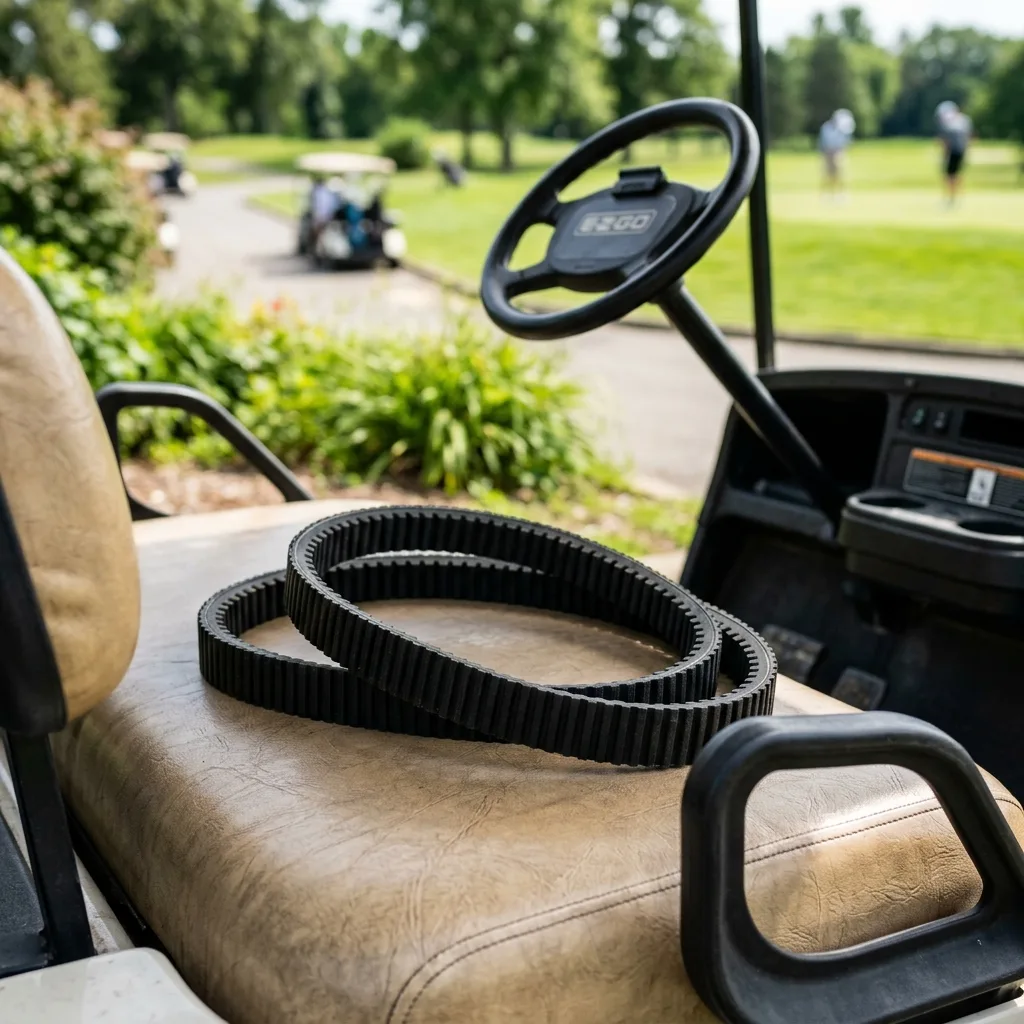
In addition to the whistling itself, you should also monitor the physical condition. Check the belt width. The standard Driven Clutch Belt is approximately one and one-eighth inches (approx. 28.5 mm) wide from the factory.
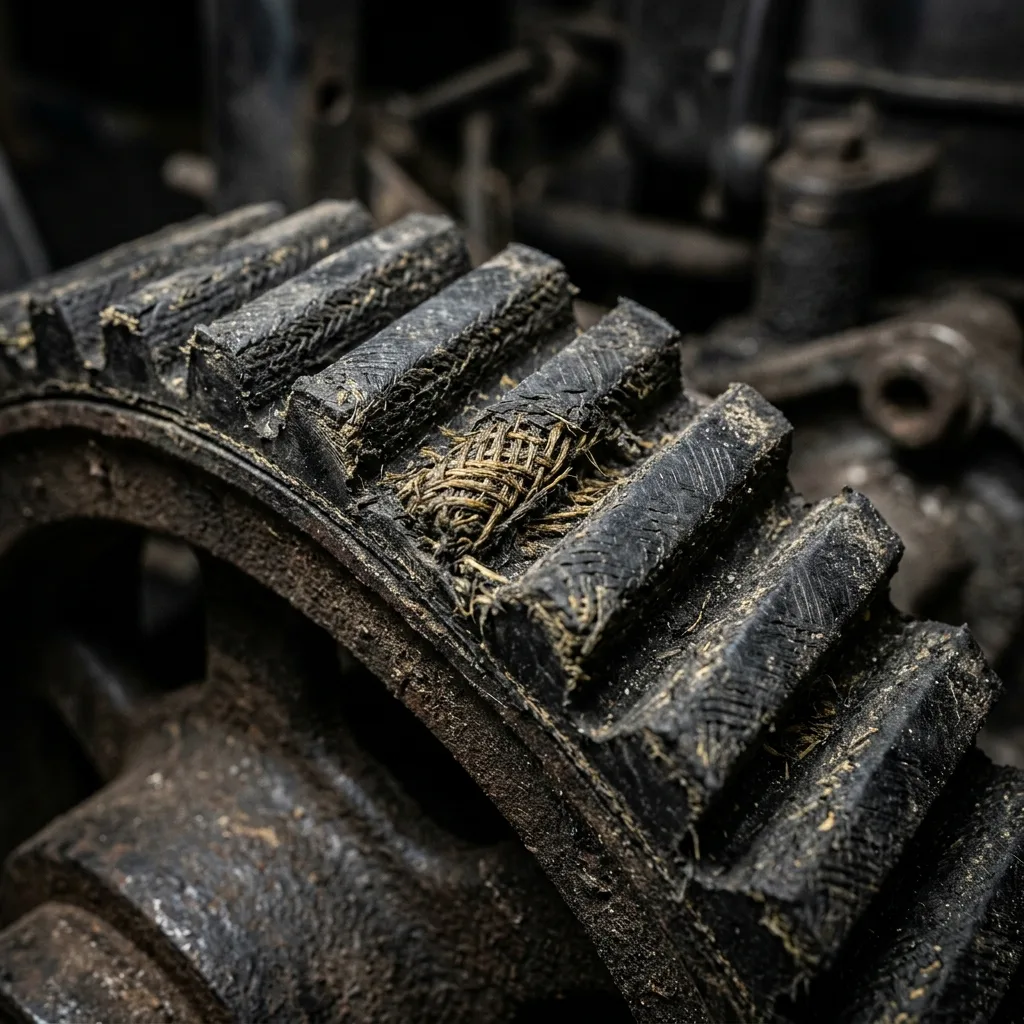
As this width decreases more than one-tenth of an inch, the belt sinks deeper into the grooves and the carriage loses traction. If you see frayed fibers, cracks, or flattened areas on the edges,schedule a service immediately.
Ignoring these symptoms unnecessarily overloads the entire engine compartment and significantly shortens the life of other mechanical parts.
Differences between models: EZGO TXT, RXV and Marathon
Although the principle of operation of the power transmission remains the same for all gasoline models, the specification of the drive belts has evolved historically. Choosing the right part directly depends on the generation of your truck.
Using the wrong length or bevel angle leads to immediate slippage or, conversely, the inability to engage gear.
EZGO Marathon (do roku 1994)
These models use a specific belt adapted to lower horsepower two-stroke or early four-stroke engines. They have different clutch geometry so the newer parts will not fit. Always check OEM numbers carefully.
EZGO TXT (od roku 1996)
This most widespread platform has implemented a standardized system. The belt must handle the specific thrust of the Robbins (later Kawasaki) engine. Edge shaping is optimized for a smooth transition between low and high revs.
EZGO RXV
The newer generation RXV has revolutionized the powertrain. The RXV is more powerful, faster and its clutches work with higher tolerances. For this reason, the belt is made of stronger composite materials.
Changing the belt from TXT to RXV is a common mistakeinexperienced owners make. Although it may appear to physically fit there, it will quickly burn out under load. Always look for the exact OEM specification for your year of manufacture.
Primary clutch and secondary clutch: How power transmission works
Understanding how exactly the variator system works is key to proper maintenance. The system consists of two main parts: a primary clutch located directly on the engine crankshaft and a secondary clutch attached to the transmission shaft.
The belt itself rotates between them.
When the engine is at rest, the primary clutch is open and the belt sits loosely on the shaft. As you step on the gas and the engine starts to accelerate, the centrifugal force pushes the weight inside the primary clutch out.
This brings the two clutch halves together and clamps the belt. The faster the engine spins, the higher the belt is pushed up the walls of the primary clutch.
It’s a similar principle to shifting to the largest front chainring on a bike. Many players spend hours selecting the perfect equipment, such as high-endgolf driversfor long shots, but completely neglect the mechanics that drive them around the course.
While the primary clutch responds to engine speed, the secondary clutch responds to torque and load from the wheels. Contains a strong tension spring and cams.
When riding flat, the belt is pulled deep into the secondary clutch, creating a heavy gear for maximum speed.
Once you hit a hill, the rear wheels put up more resistance. This resistance causes the cams in the secondary clutch to rotate, overcoming the pull of the belt and forcing it back to a larger diameter. This lowers the truck and gives it the necessary power.
If any part of this fluid dance fails, the entire power transmission system collapses.
How to replace drive belt for ez go golf cart step by step
Let’s get down to business. The replacement is straightforward, requires no special pullers or hydraulic tools, and can be done with your bare hands.
Prepare work gloves, safety glasses in case of falling debris and sufficient lighting.Make sure the truck is standing on a completely level surface, the key is in the OFF position, and the parking brake is firmly applied.
Before the intervention itself, it is important not to confuse the two different components. You will see two belts in the engine compartment. The smaller, thinner one that runs from the small electric motor to the main motor is theStarter Generator Belt. Its job is only to start the engine and charge the battery.
Today we are interested in the massive, wide belt connecting the two large aluminum clutches.
- Step 1: Safe Preparation and Access
Raise the seat or open the engine compartment service cover. Allow the engine to cool for at least an hour if the truck has been driven before. The aluminum clutch body and the exhaust itself tend to be extremely hot. - Step 2: Release the voltage on the secondary clutch
Unlike cars where you have to loosen the idler pulleys, the EZ GO system is designed to be installed by hand. Access the secondary clutch (closer to the rear axle). Grip the outer plate firmly with both hands. Push it in while turning clockwise to open the plates. - Step 3: Pull off the old belt
Pull the belt over the outer edge of the secondary clutch and rotate it slowly. The belt jumps out of the slot. Once it’s free at the back, simply pull it off the front primary clutch as well. - Step 4: Cleaning and Visual Inspection
Wipe the surfaces of both clutches with a dry cloth, removing dust and rubber residue. If the surfaces are rough and deeply grooved, you will soon need a complete replacement of the clutch mechanism. Never apply lubricants. - Step 5: Install New Part
Install the new drive belt for ez go golf cart with the lettering facing you (not upside down). First, insert the front part deep into the primary clutch groove. - Step 6: Deploy to Secondary Clutch
Pull the end over the top of the secondary clutch, open the plate by pressing and twisting, insert the belt into the gap and slowly rotate the entire clutch until it is fully engaged. - Step 7: Final Test Run
Start the engine (with rear wheels raised) and slowly apply throttle. Monitor the smoothness of the operation. If it doesn’t make any squeaking noises, you’re done.
Lift Kit Truck Specifics
Many enthusiasts upgrade their vehicles to handle more challenging terrain, mud or deep sand. Installing a lift kit and mounting massive off-road tires changes the entire geometry and physical demands on the drivetrain.
If you raise the cart a few inches and put on twenty-three inch diameter wheels instead of the standard eighteen, the wheel circumference will increase significantly. This means that the motor must develop much more torque to turn the shaft from rest.
This enormous load falls directly on the variator and its belt. A standard tire designed to ride on cut golf course turf will burn very quickly in rough terrain.
This creates a huge amount of heat that degrades the binder fibers. For modified vehicles, therefore,you absolutely need a reinforced “heavy-duty” belt, often reinforced with Kevlar or aramid fibers.
These boosted variants are a fraction of an inch shorter or wider. This minimal difference in dimensions ensures that the belt starts in the primary clutch in a more advantageous position, effectively creating a lower gear for better downforce.
If your truck suffers from jerkiness when starting in the mud, installing a special performance piece combined with a stronger secondary clutch spring will turn your slow machine into an off-road tank.
Also, don’t forget to regularly check for proper fit and the vibrations that the lift kit can transmit to the entire axle.
Are OEM belts or aftermarket alternatives worth it?
When shopping for replacement parts, you will inevitably encounter a huge price difference between original equipment supplied directly by the truck manufacturer (OEM) and non-genuine aftermarket alternatives from third-party manufacturers.
Cheaper variants often offer half the price and promise the same functionality. But is it wise to skimp on this critical spot? It depends on how you use the cart.
If you only use your machine for occasional rides on asphalt roads in a closed resort and do not ride long routes in the hills, a quality aftermarket product from a reputable manufacturer can reliably last for several seasons.
However, you mustavoid suspiciously cheapproducts from no-name Asian e-shops. These parts often do not hold the exact bevel angle.
If the angle of the belt differs by even one degree from the angle of the clutch plates, the contact area will be radically reduced, local overheating will occur and the belt will literally tear to pieces within the first ten miles of driving.
On the other hand, OEM (Original Equipment Manufacturer) components guarantee absolutely exact chemical composition, exact circumference, width and bevel angle of the edges. They have been tested by engineers precisely to the specifications of your particular engine.
Investing in an original part means peace of mind and the certainty that you are getting one hundred percent of its design potential from your machine. As a result, you save becausethe original piece often lasts three times longer than a cheap replacement.
Why the cart loses power uphill (Bogging down & Sluggishness)
One of the most common complaints from owners is a dramatic loss of speed when the cart hits a hill.
On a straight line, the engine runs smoothly and the machine reaches maximum speed, but as soon as a slight hill starts, the engine starts to hum under load, the revolutions drop, you feel a significantbogging downand the overall expression is characterized by extreme sluggishness.
While many people blame a clogged carburetor, old fuel, or a bad spark plug, more than half of the time the culprit is failure to shift the variator properly.
As we have already explained, the mechanism has to react to the increased resistance of the rear wheels on the hill and open the front clutch, while the rear clutch has to close.
If the drive tire is worn and too narrow, it can’t create enough wall pressure, it starts to slip andthe engine’s energy is burned as heatinstead of turning the wheels.
The problem can be aggravated by the secondary shaft itself if its sliding surfaces or plastic guides (buttons) are damaged. In this case, the platters get stuck in the heavy gear position and refuse to return.
The engine thus faces the situation as if you were trying to climb a steep hill on a bike in the hardest gear.
Therefore, check not only the amount of tension and the width of the belt, but also the smoothness of the operation of both mechanical parts under load. Occasional spraying of sliding parts with dry Teflon spray (never on contact surfaces with rubber!) can do wonders.
Conclusion and Tips for Regular Maintenance
Powertrain care should become your annual routine before the high season begins. Experts recommend performing a visual inspection every fifty engine hours or at least once a year if you ride recreationally.
Look for microscopic cracks at the bottom of the grooves, frayed fibers on the outer edges, or glazed (shiny) areas on the sides that indicate previous overheating and slippage.
The basis of longevity is to keep the entire engine compartment as clean as possible. Sand, mud and dust act like coarse sandpaper between the clutch and the rubber, grinding both sides in a flash.
Clean this area regularly with compressed air or a soft brush. Avoid hard starts with heavy loads in the mud, and if you have to tow heavy trailers, get a torque kit.
Prevention only costs you a few minutes of your time, but saves you hundreds of dollars in buying broken parts. Don’t wait for the cart to let you stand at the far end of the lot.
And if you’re still unsure about typical problems and symptoms, we’ve prepared below a selection of frequently asked questions and answers from our community of owners of these reliable machines.
Frequently Asked Questions
What causes the squealing noise when starting EZ GO?
Squealing is the most common symptom of a worn or loose drive belt. The belt slips on the clutches (primary or secondary clutch) instead of smoothly transmitting power.
Why does my golf cart lose power uphill?
Loss of power and bogging down are often the result of a pulled drive belt. It prevents the clutch from shifting properly, which reduces torque at the wheels.
Can I use a standard strap on the EZ GO with a lift kit?
For carts with a raised chassis (lift kit) and larger wheels, more durable performance belts (heavy-duty) are recommended, because larger wheels put more strain on the entire power transmission system.
What is the difference between a starter generator belt and a drive belt?
The starter generator belt drives the alternator and starts the gasoline engine. The drive belt is wider and transmits the power itself from the engine to the rear axle (transmission).
How often should I change the belt on the EZGO TXT?
Inspection at least once a year is recommended. Replacement is necessary when there is visible cracking, narrowing of the belt (due to wear) or when you notice sluggishness (slowed reactions).
Get our latest guides, news, and insights highlighted in your Google Search & AI Overviews.